Donor Thank-You and Acknowledgment Letters for Associations: IRS Rules, Templates, and Timing
Copy our donor thank-you letter templates, plus IRS acknowledgment rules, 501(c)(3) vs. 501(c)(6) guidance, and tips for thanking association donors fast.
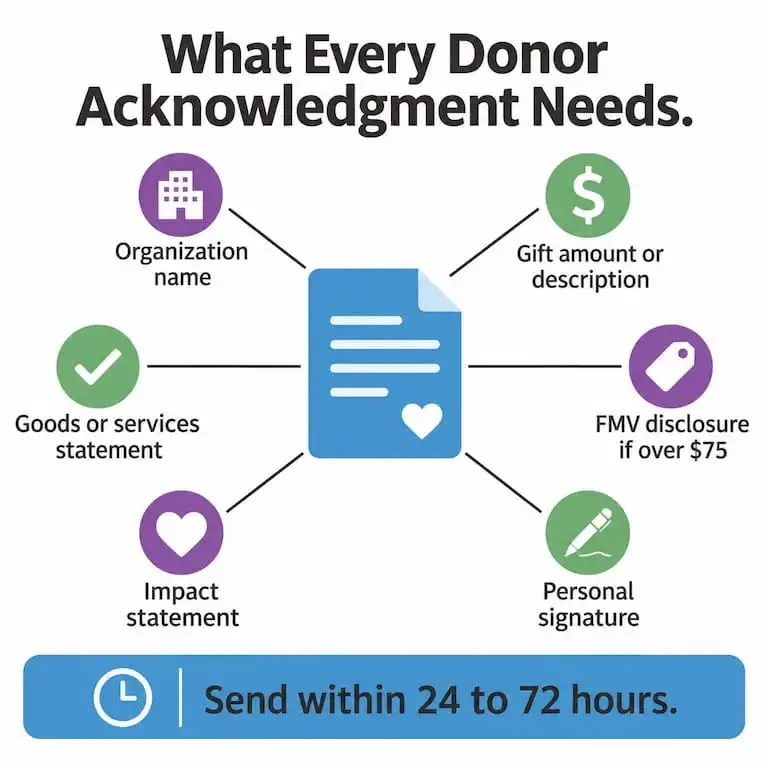
Donor thank-you and acknowledgment mail confirms a gift, meets IRS documentation rules, and shows donors the impact of their support. The strongest acknowledgments go out within 24 to 72 hours, include the gift amount and a goods or services statement, and tie the gift to a specific outcome. Get those right, and a simple thank-you becomes one of your best tools for keeping donors giving.
Below, you’ll find what the IRS requires, a copy-ready donor thank-you letter template, how to choose between mail and email, and how to keep your association print and mail programs running without overloading your team.
A description of non-cash gifts, without assigning a dollar value
A goods or services statement saying whether the donor received anything in return
A description and good faith estimate of value for any goods or services you provided
Beyond the IRS minimum, strong acknowledgments also include:
Donor name and preferred salutation
Gift date and designation, so donors have everything they need at tax time
An impact statement tied to a program, outcome, or timeline
A personal signature matched to the donor segment
Contact details for questions, matching gifts, or employer verification
A year-to-date or year-end summary reference (optional)
If the donor received nothing, say so plainly: “No goods or services were provided in return for this contribution.”
Quid pro quo gifts. When a donor receives something in return, like a gala dinner, disclose the fair market value (FMV) of what they received and the portion of their gift that’s deductible. This written disclosure is required for any quid pro quo payment over $75. Token items and other low-value benefits follow separate IRS rules, so check current guidance before you finalize your language.
Is the gift deductible at all? Many associations are organized as 501(c)(6) trade or professional organizations, and gifts to 501(c)(6) organizations aren’t deductible as charitable contributions, though donors may be able to deduct them as business expenses. Gifts to a related 501(c)(3) foundation usually are deductible. Know which entity receives each gift, and when you write your association’s end-of-year donor letter, match the tax language to the entity doing the asking. When in doubt, check with your accountant or tax advisor.
What Does a Good Donor Thank-You Letter Template Look Like?
A strong donor thank-you letter template covers the IRS essentials and still leaves room for a personal touch. Every version follows the same simple structure: open with the donor’s name and gift, explain the impact, close with gratitude and a look ahead, and add any required compliance language. Many of the principles behind a strong donor appeal letter apply here too, with gratitude in place of the ask.
Use merge fields for name, salutation, gift amount, date, and designated fund, then match your tone to the segment. Major donors may expect a formal letter signed by leadership. Grassroots donors often prefer a short, friendly email with a photo.
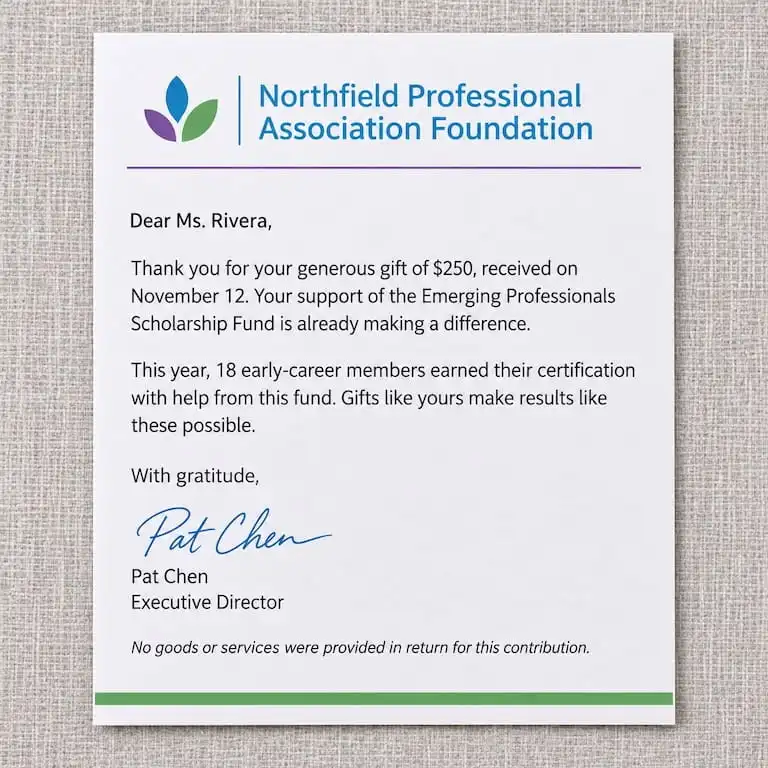
Printed Thank-You Letter Template
Dear [Preferred Salutation],
Thank you for your generous gift of $[Amount], received on [Date]. Your support of [Fund or Program] is already making a difference.
This year, [specific outcome, such as “18 early-career members earned their certification with help from our scholarship fund”]. Gifts like yours make results like these possible.
[Optional: a one-sentence story or quote from someone your gift helped.]
We’ll share an update on [Program] in [month or season]. If you have any questions about your gift, please contact [Name] at [email or phone].
No goods or services were provided in return for this contribution.
[If applicable: [Foundation’s legal name] is a 501(c)(3) organization. Tax ID: [EIN].]
Email Thank-You Template
Subject: Thank you, [First Name]. Your gift is already at work
Hi [First Name],
Thank you for your gift of $[Amount] on [Date]. Your support is helping [Program or Outcome] right now, and we can’t wait to show you the results.
Watch your inbox in [month] for an update on what your generosity made possible.
With thanks, [Name, Title]
No goods or services were provided in return for this contribution.
Quid Pro Quo Language
If the donor paid more than $75 and received something in return, replace the “no goods or services” line with:
In exchange for your contribution of $[Amount], you received [description of benefit, such as two gala tickets] with an estimated fair market value of $[FMV]. The amount of your contribution that is deductible for federal income tax purposes is $[Amount minus FMV].
Adjust It by Donor Type
Recurring donor: “Thank you for your ongoing monthly support of $[Amount]. Your generosity gives [Program] steady, reliable funding.”
In-kind donor: “We gratefully acknowledge your donation of [Description], received on [Date].” Describe the item without assigning a value.
Major donor: Add a short beneficiary story or a personal note from your executive director, and have leadership sign the letter.
Member donor: Recognize their membership and loyalty, and make clear how a donation differs from dues, including which portion, if any, is deductible.
501(c)(6) association gift: Remove all deductibility language and the tax ID line, and include your required non-deductibility statement instead.
Should You Send Donor Acknowledgments by Mail or Email?
Most associations need both. The right mix depends on gift size, donor preference, and how much production your team can handle in-house.
Choose email for instant confirmation of online and recurring gifts.
Choose a printed letter for major gifts, first-time donors, corporate partners, and year-end statements. Corporate letters should reflect sponsorship benefits and include FMV disclosures.
Choose personal notes from staff or board members for mid-level and major donors.
Choose both for larger gifts. An email confirms the gift right away, and a printed letter follows within a week with the fuller impact story.
Always respect each donor’s communication preferences.
Once you know what you’re printing, the next decision is how you’ll produce it. Match your production approach to your volume:
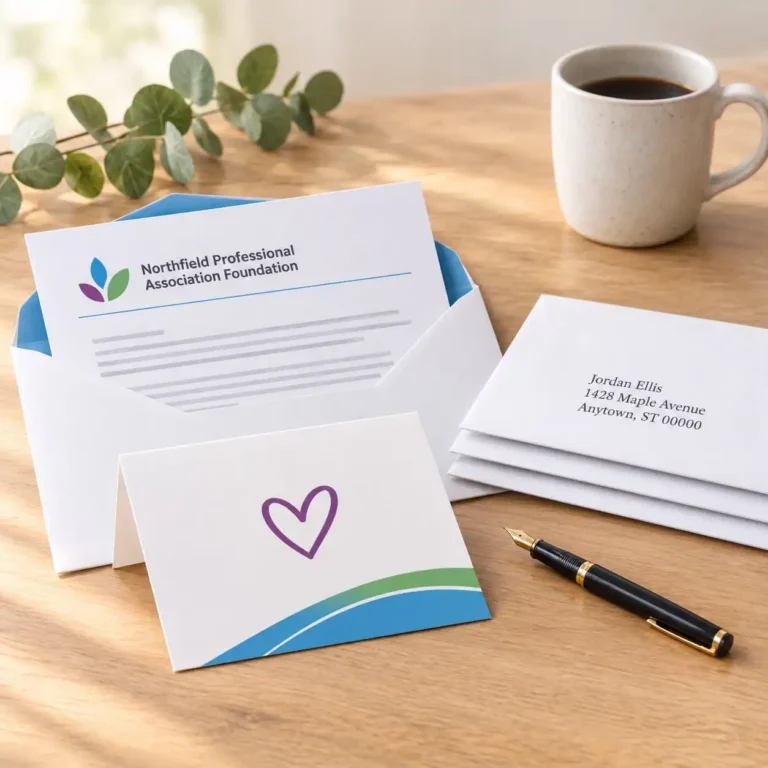
A few letters a week? On-demand printing lets you order exactly what you need as gifts arrive, with no minimums and no stacks of outdated letterhead. Order by 10 p.m., and materials can arrive as early as 8 a.m. the next day.
Mailing straight to donors? Our end-to-end direct mail services handle printing and mailing. Variable data printing personalizes each letter with the donor’s name, gift amount, and designation, and tracking with downloadable reports shows you when acknowledgments land.
Chapters or staff ordering their own? A Mimeo Marketplace storefront gives your team approved letterhead, envelopes, and note cards that stay on brand every time.
What Are the Best Practices for Sending Acknowledgment Mail?
Move fast. Send acknowledgments within 24 to 72 hours, with instant email confirmation for online gifts. Set up CRM workflows that trigger the right acknowledgment by gift type and segment. For larger gifts, use two steps: an automatic confirmation, then a personal letter or call within a week. Schedule year-end summaries for January so donors have them in time for tax prep, and map every send on a member and donor mail calendar so nothing slips during the busy season.
Check the details. Verify names, salutations, and addresses. Standardize how you format currency and dates. Proof printed letters before production, and spot-check batches for alignment, signatures, and enclosures.
Track and improve. Monitor send times, delivery rates, email opens and clicks, stewardship response, donor feedback, and compliance misses. Segment results by donor type to see where personalization pays off. A/B test subject lines, openings, and impact statements, and review your templates on a regular schedule.
How Can Associations Keep Donors Engaged After the Thank-You?
Share impact. Send quarterly reports with progress toward goals, beneficiary stories, and clear metrics.
Invite them in. Offer webinars, site visits, or member briefings tied to their interests.
Recognize supporters. Feature donors in annual reports or on donor walls, with an easy opt-out.
Celebrate milestones. Mark giving anniversaries and cumulative giving levels.
Personal touches don’t have to be expensive. Handwritten notes, short videos from program staff, and a P.S. that references a donor’s interests all go a long way. For higher-touch stewardship, consider small-group briefings with leadership, recognition events, or named fund updates with measurable outcomes.
Measure the return. Track retention, average gift size, upgrade rates, and referrals among donors who receive enhanced stewardship. Compare against a control group when you can, and calculate your cost per retained donor. Those numbers make the case for investing in gratitude.
How Should You Handle Year-End and Special-Case Acknowledgments?
Year-end giving. Acknowledgment volume peaks at year-end, so plan it alongside your year-end giving campaign for associations. Prepare scalable templates, pre-approved FMV language, and a production calendar that covers print and digital deadlines. Set up consolidated receipts for recurring and multi-gift donors. When statements go out to thousands of donors at once, bulk direct mail for large member bases keeps big runs on schedule.
Recurring gifts. Monthly or annual summaries work well, as long as they list each date and amount and include the goods or services statement.
In-kind gifts. Describe what you received, skip the dollar value, and note whether the donor got anything in return.
Donor-advised fund (DAF) grants. The donor already received a tax acknowledgment from the fund’s sponsoring organization. Send your formal acknowledgment to the sponsor, and send the donor a warm thank-you without receipt language. DAF grants also can’t cover personal benefits like event tickets, so don’t offer any in exchange.
Events and campaigns. Set benefit values in advance, and make sure staff know how to explain deductible amounts.
Corporate and foundation donors. Align acknowledgments with grant or sponsorship requirements, including any reporting commitments.
Matching gifts. Give donors employer-specific guidance and verification details to speed up processing.
Memorial and tribute gifts. Thank the donor, and notify the honoree’s family when appropriate, without sharing the gift amount. Use language that conveys respect and care.
Frequently Asked Questions
How soon should you send a donor acknowledgment?
Aim for 24 to 72 hours after you receive the gift. For online donations, send an automatic email confirmation right away, then follow up with a personal letter for larger gifts.
What should a donor thank-you letter template include?
At minimum: your organization’s name, the gift amount or a description of non-cash gifts, a goods or services statement, and an impact line tied to a specific program. Add the donor’s name, gift date, and a personal signature to make it feel human.
Do you need to send an acknowledgment for gifts under $250?
The IRS written acknowledgment requirement applies to single gifts of $250 or more, but every donor deserves a thank-you. A prompt receipt also gives smaller donors the written record they need for their own files.
Can an email count as an official acknowledgment?
Yes. An email can serve as a written acknowledgment, as long as it includes the same required details as a printed letter.
What’s the difference between a thank-you letter and an acknowledgment?
An acknowledgment documents the gift for tax purposes. A thank-you letter expresses gratitude and shows impact. The best donor letters do both in one piece.
Should donor-advised fund grants get a tax receipt?
No. The donor already received a receipt from the fund’s sponsoring organization. Send the formal acknowledgment to the sponsor and a warm thank-you to the donor.
Make Every Thank-You Count
Your donors deserve a thank-you that arrives on time and looks the part. We make it simple to print and mail acknowledgment letters, year-end statements, and stewardship pieces, so your team can focus on relationships. Start printing your donor acknowledgment mail with Mimeo.
Things to Remember
Send acknowledgments within 24 to 72 hours of every gift.
Confirm whether gifts go to a 501(c)(3) or a 501(c)(6) before you write receipts.
Include every IRS-required element, plus a goods or services statement.
Disclose FMV for any quid pro quo gift over $75.
Start from a template, then personalize by donor segment.
Pair fast email confirmations with printed letters for major gifts and year-end.
Track results and refresh your templates regularly.
Alex Otte is an Account Executive at Mimeo, where he has spent eight years across account management and sales roles, building deep expertise in how businesses buy and manage print. Based in Minneapolis, he draws on consultative selling training and a strong foundation in client communication and product demonstrations to guide customers toward solutions that actually fit their needs. He works closely with nonprofits and associations to help them make the most of tight budgets without sacrificing quality. His posts help businesses cut through the noise and make smarter print and distribution decisions.




 By Alex Otte
•
17 Nov 2026
•
11 min read
•
Industry Applications

 Mimeo Print
 Mimeo Digital for Participants
 Mimeo Marketplace
 PrintX
 Mimeo Photos