



 By Brent Ervin-Eickhoff
•
2 Oct 2026
•
Updated 6 Oct 2026
•
10 min read
•
Industry Applications
By Brent Ervin-Eickhoff
•
2 Oct 2026
•
Updated 6 Oct 2026
•
10 min read
•
Industry Applications
The best year-end giving campaigns for associations start in October, not December. Build your mail timeline backward from Giving Tuesday and December 31, choose your appeal package (letter, reply card, and envelope) by donor segment, and track every response back to its source. Here’s how to do each step without the last-minute scramble, plus how we support associations with print and fulfillment throughout the giving season.
Why does year-end giving matter so much for associations?
Giving picks up sharply in late Q4 as donors finalize contributions before December 31. Members who engaged with you all year are especially receptive now, which makes this the right moment for mission-centered storytelling and renewal asks.

Year-end gifts often fund a large share of the annual budget, including programs, scholarships, advocacy, member services, and professional development. Securing commitments before January lets you confirm staffing, reserve venues, and launch initiatives on schedule. A strong finish also takes pressure off spring campaigns and gives your board better numbers to plan with.
Different donors respond to year-end appeals in different ways:
- One-time donors respond to clear deadlines, tangible outcomes, and suggested gift amounts.
- Recurring supporters want impact updates and an easy way to increase their monthly gift.
- Major donors and corporate partners often plan gifts earlier, sometimes through donor-advised funds (DAFs) or employer matches, and may want to fund a challenge gift that motivates others.
A quick note on tax language: gifts are tax-deductible as charitable contributions only if they go to a 501(c)(3). Many trade and professional associations are 501(c)(6) organizations, and the IRS treats contributions to 501(c)(6) organizations differently. If you fundraise through a related foundation, make sure your appeals and receipts name the right entity.
When should associations mail year-end appeals?
Work backward from your two anchor dates. In 2026, Giving Tuesday falls late, on Tuesday, December 1, because Thanksgiving is on November 26. That compresses the window between Giving Tuesday and December 31, so your mail needs to be in homes earlier than you might expect.
| Timing | Milestone |
|---|---|
| Mid-October | Lock segments, ask amounts, and match or challenge commitments |
| Late October | Finalize copy, design, and approvals for the letter, reply card, and envelope |
| Late October to early November | Send data files to your print partner and approve proofs |
| Week of November 2 | Drop the main appeal |
| Weeks of November 9 and 16 | Main appeal arrives in homes |
| Week of November 16 | Drop a Giving Tuesday teaser postcard so it lands before Thanksgiving week |
| December 1 | Giving Tuesday: email, social, and match announcement |
| Week of December 7 | Drop a final reminder to non-responders, using First-Class Mail for speed |
| December 14 to 18 | Final reminder arrives, giving donors two weeks to respond |
| December 31 | Final email push and last day for gifts to count toward 2026 |
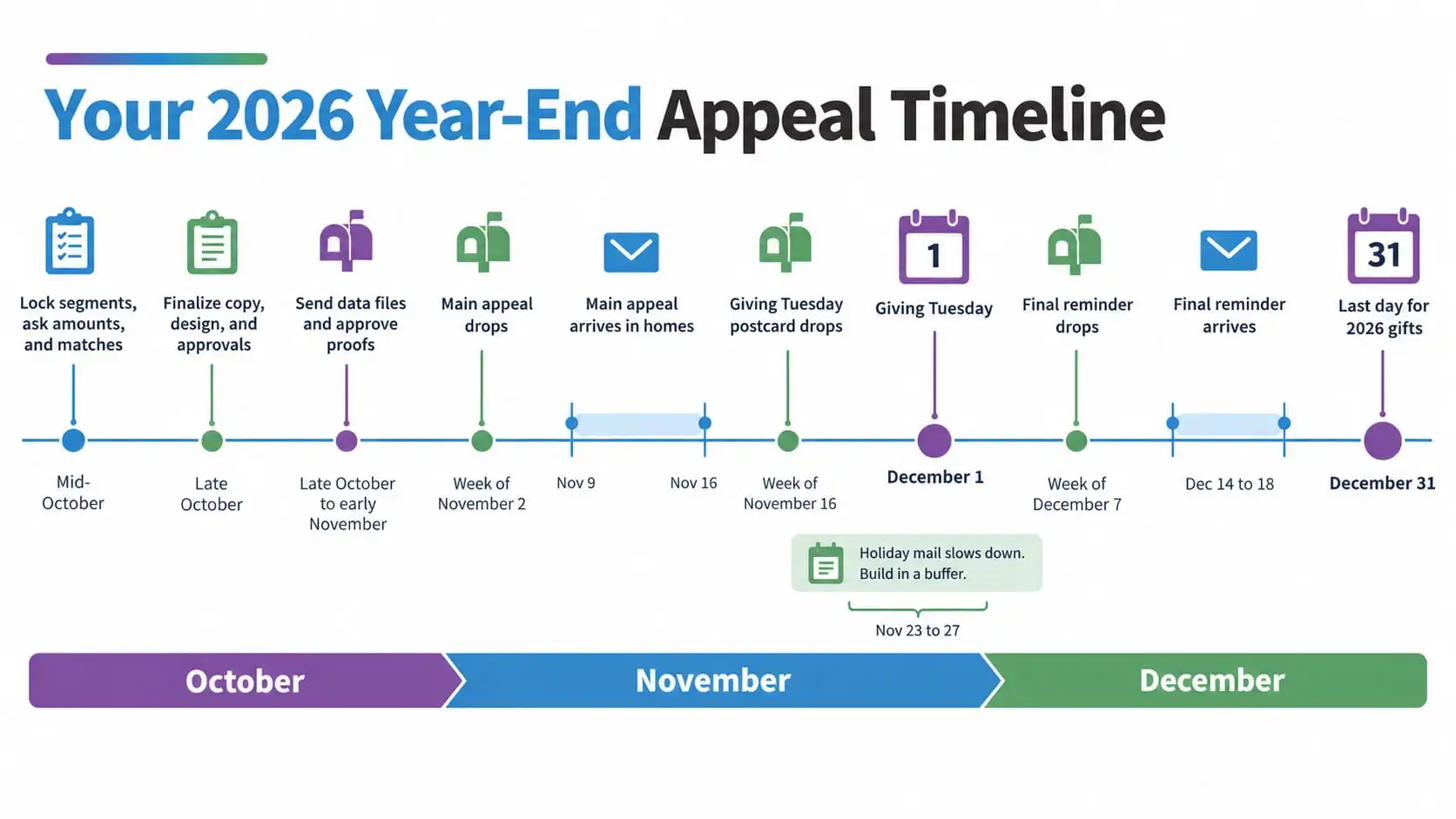
Holiday mail volume slows delivery, and Thanksgiving week is especially tight. Build in a buffer at every step.
There’s one more reason to mail early this year. Under a USPS rule that took effect in late 2025, machine postmarks are applied at regional processing centers instead of local post offices, so the postmark date can trail the actual mailing date by several days. Because the IRS still uses the postmark to date mailed charitable gifts, a contribution meant for one tax year can count toward the next if it’s processed in January. In your December mailings, encourage donors to give online or mail their reply early. If they plan to mail close to the deadline, a hand-stamped postmark at a USPS counter records the exact day USPS receives the mail. This guide from The Foundation for Enhancing Communities covers the change in more detail.
What should go in a year-end appeal package?
Your appeal package has three working parts. Each one is a production decision that affects response.
The letter
The letter carries your story and your ask. Lead with one specific outcome a gift makes possible, then make the ask early and repeat it near the end. Keep paragraphs short and add a P.S., since many readers skim straight to it. Personalize the salutation, reference the donor’s relationship with you (conference attendance, committee service, certifications), and have a leader whose name members recognize sign it. For more on copy, see our tips for writing a donor appeal letter that resonates.
The reply card
The reply card is where the gift happens, so make it effortless. Prefill the donor’s name and address, show a gift array tailored to their giving history, and add a monthly giving checkbox. Include a QR code to your donation page, a reminder of your match or challenge, and a short note to give online or mail early for year-end credit. Print a source code on every card so you can track which mailing drove each gift.
The envelope
Your outer envelope decides whether the package gets opened. A personalized or teaser envelope works well for broad audiences, while a clean, letter-style envelope feels more personal for loyal and major donors. Include a reply envelope sized to fit the reply card so responding takes zero effort.
How do you choose the right format for each donor segment?
Match the investment to the relationship. Your most loyal supporters deserve the full package, while lapsed or lower-engagement segments may respond just as well to a lighter format.
- Major donors and board-level supporters: A personalized letter package with a reply envelope, followed by a handwritten note or phone call.
- Current and recurring donors: A letter package with a tailored gift array and an upgrade ask.
- Lapsed donors: A shorter letter that acknowledges their past support and gives one clear reason to return.
- Members who haven’t given yet: A postcard tied to Giving Tuesday or your match, with a QR code to give online.
- Everyone, after the campaign: A printed impact report or newsletter that shows what their gifts made possible.
We print and mail all of these formats, including letter mailers with reply envelopes, postcards, newsletters, and brochures. Because we print on demand, you can refresh your data close to each drop and suppress donors who already gave, so nobody gets a reminder after writing a check. Explore our direct mail services or browse more direct mail formats for associations.
How do you track a year-end mail campaign?
Tracking tells you what worked, what to fix mid-campaign, and where to invest next year. Set it up before the first drop:
- Source codes on every reply card so each mailed gift ties back to a specific package and segment.
- QR codes and personalized URLs (PURLs) so online gifts from mail recipients are credited to the mailing.
- USPS mail tracking so you know when each drop actually lands and can time your follow-up emails to match.
- A shared dashboard showing dollars, gift count, average gift, response rate, and match progress by segment.
After December 31, compare results against your goals and note which segments upgraded, lapsed, or responded to a lighter format. These direct mail fundraising metrics are a good starting point.
How should associations thank and steward year-end donors?
Thank donors quickly and specifically. Send an email receipt immediately with the correct tax language, then follow with a personalized acknowledgment within a week. Review the IRS substantiation and disclosure requirements so your receipts cover gifts of $250 or more and any gift that includes event tickets or other benefits. For significant gifts, add a phone call within 48 hours.
Then close the loop. Within 60 to 90 days, share an impact report or story that combines member testimonials with outcomes like scholarships awarded, certifications supported, or advocacy wins. Donors who see their impact are more likely to give again, upgrade, and stay engaged through committees, events, and mentoring.
What operational details keep year-end giving running smoothly?
- Set processing cutoffs. Coordinate with finance on deadlines for checks, wire transfers, stock gifts, and DAF gifts, and plan a post-campaign reconciliation.
- Optimize your donation page. Keep form fields minimal, make it mobile-friendly, and offer multiple payment options, including credit cards, ACH (automated clearing house) transfers, digital wallets, and an employer match lookup.
- Test the full journey. Walk through the QR code, donation form, confirmation email, and thank-you page on desktop and mobile.
- Lock in print partners early. Confirm drop dates, data file deadlines, and inventory for letterhead, envelopes, and inserts before November. If you also need donor packets or event collateral, give your partner those dates too. Pre-approved templates and automated printing for nonprofit teams cut down on proof rounds when the calendar gets tight.
Frequently Asked Questions
When should associations mail their year-end appeal?
Aim to have your main appeal in homes by mid-November, with a final reminder arriving by December 18. In 2026, Giving Tuesday falls on December 1, so plan a teaser mailing that lands before Thanksgiving week.
Do donations to associations qualify for a tax deduction?
Only gifts to a 501(c)(3) qualify as charitable deductions. Many associations are 501(c)(6) organizations, so if you fundraise through a related foundation, make sure appeals and receipts name the foundation.
What should a year-end reply card include?
Prefilled donor details, a tailored gift array, a monthly giving option, a QR code, a source code for tracking, and a note encouraging donors to give online or mail early.
How do you know which mailing drove a gift?
Print a unique source code on each reply card and use segment-specific QR codes or PURLs. Then match gifts back to codes in your donor database.
Should every donor get the same appeal package?
No. Reserve full letter packages for loyal and major donors, and use lighter formats like postcards for lapsed donors and members who haven’t given yet.
Ready to plan your year-end mailings?
The calendar is tighter than usual this year, so the earlier you lock in your timeline, the more room you have to get it right. We’ll help you print, mail, and track every piece, from your main appeal to your final reminder. Start planning your year-end appeal with us.
Things to Remember
- Build your mail timeline backward from Giving Tuesday (December 1, 2026) and December 31.
- Get your main appeal into homes by mid-November and your final reminder by December 18.
- Encourage donors to give online or mail early, since postmarks may no longer reflect the drop-off date.
- Treat the letter, reply card, and envelope as separate production decisions that each affect response.
- Match your package format to each donor segment.
- Put source codes, QR codes, and USPS tracking in place before the first drop.
- Confirm whether gifts go to a 501(c)(3) foundation before using tax-deductible language.
- Thank donors within days and report impact within 60 to 90 days.
What you should read next

Brent Ervin-Eickhoff
Director of Marketing
Brent Ervin-Eickhoff is a Chicago-based marketer with B2B and B2C experience spanning corporations, agencies, and non-profits, including five years of experience in print. From Volkswagen to the University of Chicago, his background is focused in crafting marketing campaigns that drive results.

 Mimeo Print
 Mimeo Digital for Participants
 Mimeo Marketplace
 PrintX
 Mimeo Photos