




 By Alex Otte
•
18 Nov 2026
•
7 min read
•
Industry Applications
Starting with 2026 taxes, donors who don’t itemize can deduct up to $1,000 in cash gifts to qualifying charities, or $2,000 for married couples filing jointly. That gives your year-end appeal a concrete new reason to give, and most of your donors can use it.
For associations, how you mention it depends on how your organization is set up. Below, we’ll cover who qualifies, how to word it in your letter, and how to get a final appeal in the mail before Dec. 31.

What is the new charitable deduction for non-itemizers?
The One Big Beautiful Bill Act, signed in July 2025, created a permanent “above-the-line” charitable deduction starting with the 2026 tax year. Above-the-line means donors can claim it even when they take the standard deduction. The IRS covers the basics in its charitable contribution deduction tips for non-itemizers.
- How much: Up to $1,000 for single filers and $2,000 for married couples filing jointly.
- What counts: Cash gifts, including checks, credit cards, and online donations. Gifts of stock or property don’t count toward it.
- Who benefits: Donors who take the standard deduction, which is most taxpayers.
- How long it lasts: It’s permanent, so this message can carry into future appeals too.
For years, small and midlevel donors had no tax incentive to give. Now they do, and your appeal is the perfect place to tell them.
Does the new deduction apply to gifts to my association?
It depends on who’s asking. The deduction covers cash gifts to qualifying charities, so here’s how it shakes out:
- 501(c)(3) organizations and foundations: Cash gifts to most public charities qualify, though certain organization types are excluded.
- 501(c)(6) trade and professional associations: Gifts to the association itself typically aren’t deductible as charitable contributions, so the new deduction likely won’t apply.
- Donor-advised funds: Gifts to a donor-advised fund don’t count toward the new deduction.
If your association has a charitable foundation, the foundation’s appeal is the natural home for this message. Confirm your foundation’s status first, since not every type of charitable organization qualifies. You can look it up with the IRS Tax Exempt Organization Search tool.
If the association itself is asking, leave the deduction out and lead with impact. Our guide on how to write your association’s end-of-year donor letter covers how to match your tax language to the entity doing the asking.
When in doubt, check with your accountant before anything goes to print.
How should we mention the deduction in a year-end appeal letter?
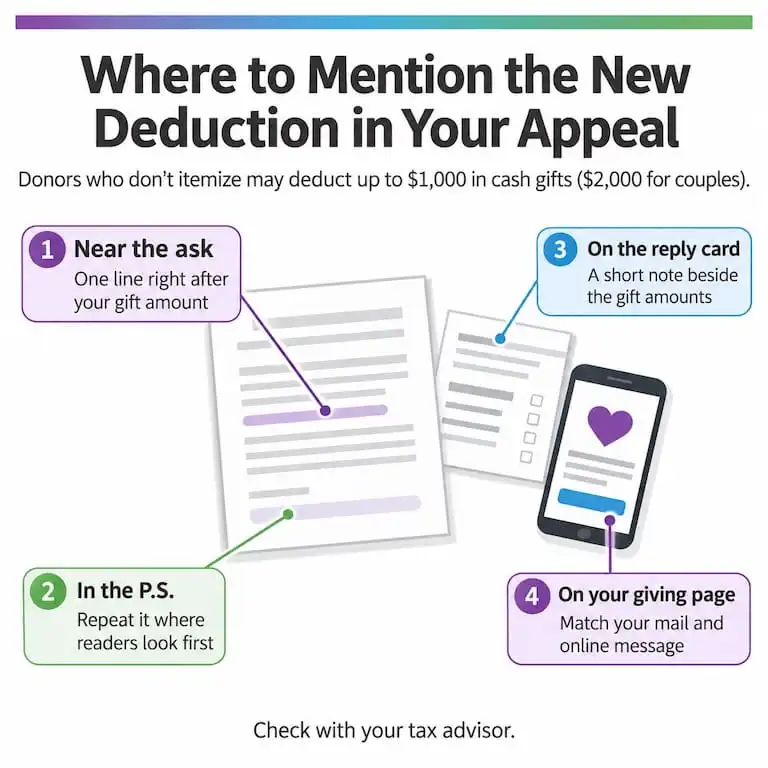
Keep it short, accurate, and close to the ask. Donors skim appeal letters, so put the message where their eyes land:
- Near the ask: One sentence right after your suggested gift amount.
- In the P.S.: Often the most-read part of the letter.
- On the reply card: A brief reminder beside the gift amounts.
- On your giving page: So your mail and online messages match.
Here are sample lines you can adapt:
“New this year: even if you don’t itemize, your gift of up to $1,000 ($2,000 for couples) may be tax deductible.”
“P.S. Thanks to a new tax rule, gifts made by Dec. 31 may lower your 2026 taxes, even if you take the standard deduction. Please check with your tax advisor.”
Keep the language informational. Include a “check with your tax advisor” line, and don’t promise a specific savings amount.
Should donors who itemize get a different message?
Yes, if your donor data supports it. Starting in 2026, itemizers face a new floor: only charitable gifts above 0.5% of adjusted gross income (AGI) count toward their deduction. For a household earning $200,000, the first $1,000 in gifts produces no deduction.
That means the non-itemizer headline won’t resonate with your biggest supporters. Try segmenting instead:
- Most donors (likely non-itemizers): Lead with the new $1,000 or $2,000 deduction.
- Major and midlevel donors (likely itemizers): Focus on impact, matching gifts, or multiyear pledges, and suggest they talk to their advisor.
You don’t need separate print runs. Variable data printing lets you swap the tax paragraph by segment within a single run, so each donor gets the version that fits them. Our guide to personalized fundraising direct mail shows how tailored messages lift donor engagement.
Is it too late to send a year-end appeal?
No. Gifts made by Dec. 31 generally count toward 2026 taxes, and December is one of the busiest giving months of the year.
If your main appeal already went out without the deduction message, add it to your final reminder to non-responders. A postcard is the fastest option. There’s no new letter to write, just the new tax line, your deadline, and a QR code so donors can give online and their gifts arrive in time. For drop dates, see our 2026 year-end mail timeline for associations, and for the rest of the year, plan a year of member and donor mail. Here’s sample postcard copy:
“There’s still time to make a difference in 2026. New this year: your gift may be tax deductible even if you don’t itemize. Give by Dec. 31 at [your URL]. Check with your tax advisor.”
How do you choose where the deduction message goes?
It depends on where your appeal is in production. Use this to pick the right piece:
| Where your appeal stands | Best piece for the message | Why it works |
|---|---|---|
| Not designed yet | Updated letter and reply card | The message sits right next to the ask |
| Designed but not printed | Printed insert | Adds the message without reworking the letter |
| Already mailed | Follow-up postcard | Reaches non-responders before Dec. 31 |
| Gifts coming in | Thank-you letter | Reminds donors their gift may help at tax time |
Whichever piece you choose, our end-to-end direct mail services can print, mail, and track it, so you know when it lands and can time your follow-up email. Need printed materials for a year-end board meeting or donor event too? Order by 10 p.m. and they can arrive as early as 8 a.m. the next day.
Ready to get your final appeal in the mail? Our team can help you plan, print, and track your year-end campaign so it lands before Dec. 31. Get started with Mimeo.
Frequently Asked Questions
Can donors claim the new deduction for gifts to a donor-advised fund?
No. Gifts to donor-advised funds don’t count toward the non-itemizer deduction. Donors need to give directly to a qualifying charity.
Should we mention the new deduction in our thank-you letters?
You can. A short, general line noting that gifts to qualifying charities may be deductible under the new rule is a nice touch. Keep your standard acknowledgment details intact, and see our guide to donor thank-you and acknowledgment letters for what to include.
Does the deduction apply to gifts of stock?
No. The non-itemizer deduction covers cash gifts only. Gifts of appreciated stock may still benefit donors who itemize.
What’s the deadline for a gift to count toward 2026 taxes?
Gifts generally need to be made by Dec. 31, 2026, to count toward 2026 taxes. That’s why a late-December appeal can still make a difference.
Things to remember
- Starting with 2026 taxes, non-itemizers can deduct up to $1,000 ($2,000 for joint filers) in cash gifts.
- It applies to qualifying charities, so 501(c)(6) associations may want to point appeals to their foundation.
- Dues, gifts to donor-advised funds, and gifts to some other organization types generally don’t qualify.
- Mention the deduction near the ask, in the P.S., and on the reply card, with a “check with your tax advisor” line.
- Itemizers face a new 0.5% of AGI floor, so segment your message by donor type.
- A follow-up postcard is the fastest final touch before Dec. 31.
What you should read next
Alex Otte
Account Executive
Alex Otte is an Account Executive at Mimeo, where he has spent eight years across account management and sales roles, building deep expertise in how businesses buy and manage print. Based in Minneapolis, he draws on consultative selling training and a strong foundation in client communication and product demonstrations to guide customers toward solutions that actually fit their needs. He works closely with nonprofits and associations to help them make the most of tight budgets without sacrificing quality. His posts help businesses cut through the noise and make smarter print and distribution decisions.

 Mimeo Print
 Mimeo Digital for Participants
 Mimeo Marketplace
 PrintX
 Mimeo Photos