



 By Brent Ervin-Eickhoff
•
10 Nov 2026
•
7 min read
•
Direct Mail & Print Marketing
Postcard marketing is a direct mail strategy that uses printed postcards to deliver an offer, update, or invitation to a targeted list. There’s no envelope to open, so your message and call to action are visible the moment someone picks up their mail. Here’s how to choose the right postcard campaign, build a sequence, and write cards that earn a response.
What Is Postcard Marketing?
Postcard marketing means sending custom printed postcards to a defined audience to drive one specific action, like registering for an event, redeeming an offer, or renewing before a deadline. It’s the simplest format within direct mail marketing, because your entire message fits on two sides of a single card.
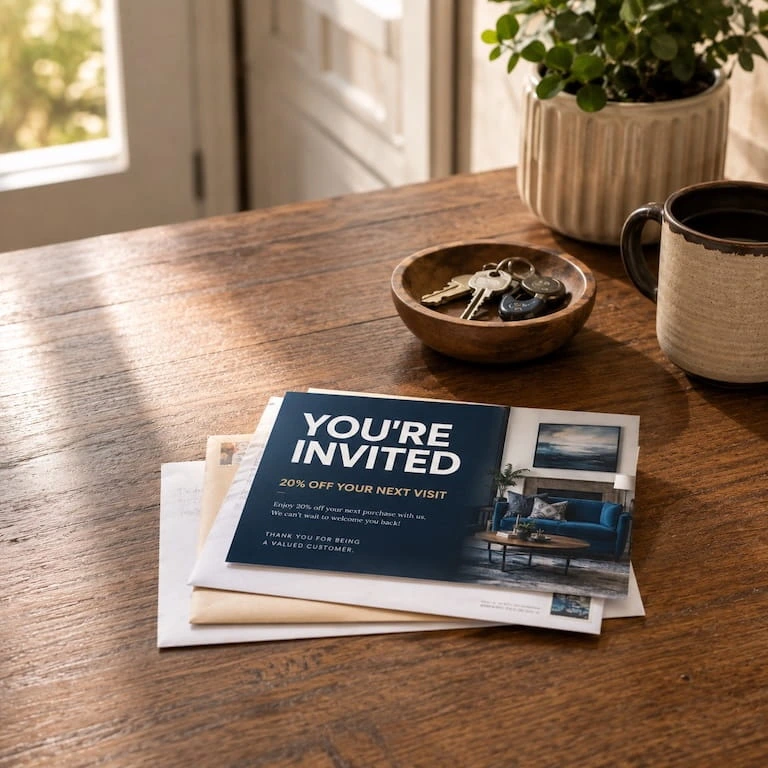
Postcards are the right choice when your message fits in a headline and a sentence or two, and when you’re asking for one simple next step. If you need room for detailed product information or a personal letter, see how postcards stack up in our breakdown of direct mail formats.
Why Do Postcards Work So Well?
Postcards remove every barrier between your message and your reader. Recipients see your headline and offer without opening, clicking, or scrolling. A good card can be understood in the few seconds it takes to sort the mail, and it often stays on a desk long after it arrives.
The broader channel performs, too. According to the 2024 ANA Response Rate Report, direct mail sent to existing customers averages a 5% to 9% response rate, while mail to prospect lists averages 4% to 5%.
What Types of Postcard Campaigns Can You Run?
Each campaign type calls for a different card. Here’s what to put front and center for the most common ones.
- Event invitations: Lead with the event name and date on the front. Use the back for two or three agenda highlights and a QR code to register.
- Event reminders: Send a week or two before the date. Make the date and location the biggest elements on the card, and repeat the registration link.
- Renewal and deadline notices: Put the deadline in large type on the front. Spell out what recipients lose if they miss it, and give them one fast way to act.
- Win-back offers: Acknowledge that it’s been a while, then make a specific offer worth returning for. Keep it warm and skip the guilt.
- Post-event follow-ups: Thank attendees, then point them to one next step, such as session recordings, a consultation, or an early-bird offer for next year.
- Triggered postcards: A welcome card after signup or a congratulations card after someone completes a course. These work best when they mail automatically based on customer actions.
How Do You Build a Postcard Sequence?
One postcard rarely does the job alone, especially with a new audience. A short sequence gives recipients time to recognize you before you ask for action. Before you build one, nail down your goal, audience, and offer. We cover those fundamentals in our guide to how direct mail campaigns work.
A simple three-card sequence looks like this:
- Card one: Introduce. Lead with the problem you solve and a clear benefit. Include your offer, but let the message do the heavy lifting.
- Card two: Prove it. Share a customer result, a quick stat, or a testimonial. Restate the offer.
- Card three: Close. Put the deadline front and center. Make this the most direct card in the series.
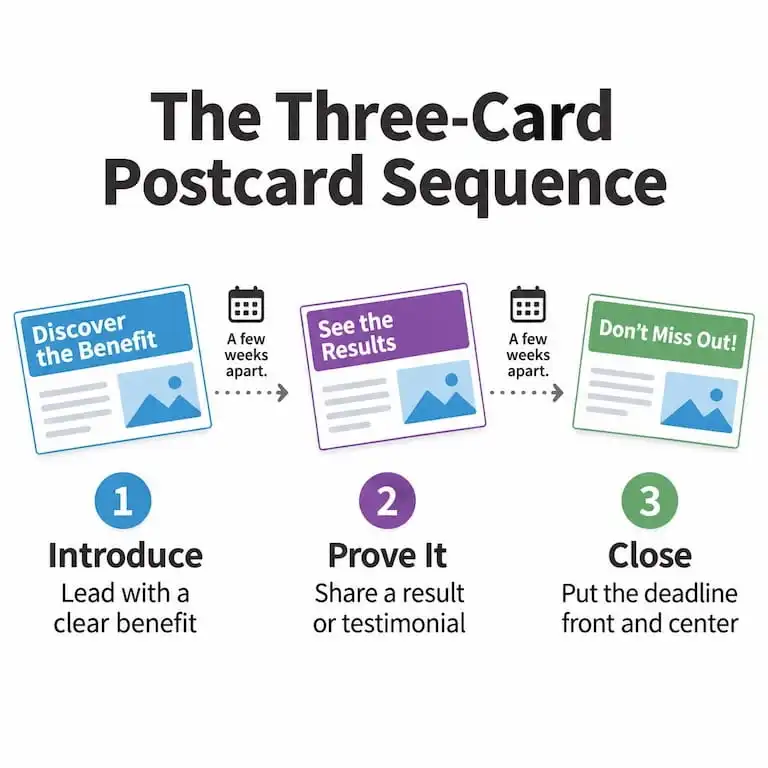
Space cards a few weeks apart, and keep your design consistent across the series so each one builds recognition. Change your headline and supporting message, but keep the offer and call to action the same.
What Should Go on the Front and Back of a Marketing Postcard?
Give each side a clear role.
The front earns the flip. Use one strong visual, one benefit-focused headline, and a hint of the offer. Resist the urge to add more.
The back closes the deal. Include:
- Offer details and the deadline
- A clear call to action
- A QR code, promo code, or short URL
- Your phone number or address
- Space for the mailing address and postal barcode
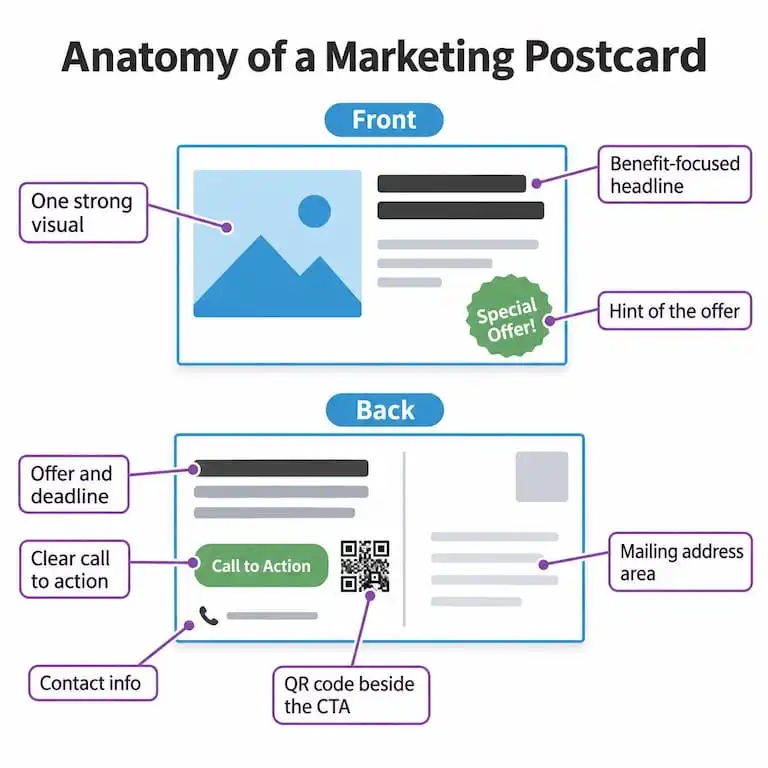
Write the back for skimmers. Short lines, plain language, and a call to action that stands out from everything around it. For guidance on choosing postcard sizes and paper stock, see our full breakdown.
How Do You Make a Postcard Trackable?
Tracking starts with the card itself, not your analytics dashboard.
- Place your response method next to your call to action. A QR code buried in a corner gets skipped. Put it right beside the line asking people to act.
- Print codes large enough to read and type. Recipients shouldn’t need to squint at a promo code or short URL.
- Match your landing page to your card. Use the same headline, imagery, and offer so people know they’re in the right place the second they arrive.
- Give every version its own code. If you test two headlines or mail two segments, each needs a unique code or URL. Otherwise you can’t tell which one worked.
Once responses come in, compare them using the metrics in our guide to measuring direct mail results.
Should You Run One-Off Postcard Drops or an Automated Program?
Your answer shapes how you produce and send your cards.
One-off drops fit event invitations, seasonal offers, and announcements. You build the list, approve the design, and mail everything at once. We’ll print and mail your custom postcards, with tracking and downloadable reports so you can see how each campaign performed.
Automated programs fit triggered mail like welcome cards, renewal reminders, and course completion notes. Instead of building a new campaign each time, cards mail on their own when a customer takes an action. Mimeo APIs can trigger direct mail from your own systems, so the right card goes out at the right moment without manual uploads.
Many teams run both: one-off drops for campaigns, and an automated program for the moments that happen every day.
Postcard Marketing FAQ
What is a good response rate for postcard marketing?
According to the 2024 ANA Response Rate Report, direct mail sent to existing customers averages a 5% to 9% response rate, while mail to prospect lists averages 4% to 5%. Your results will depend on your list quality, offer, and timing, so use these numbers as a starting benchmark.
How often should you send marketing postcards?
For new prospects, plan a sequence of two or three postcards over several weeks. For current customers, tie mail to meaningful moments like renewals, reorders, or upcoming events.
How much text should a marketing postcard have?
Less than you think. Aim for one headline on the front and a few short lines on the back. If you can’t explain your offer in a sentence or two, consider a format with more room.
Why do marketing postcards get ignored?
The most common reasons are a vague headline, too much text, no clear offer, or a call to action that’s hard to find. Fix those four and you’ve solved most postcard performance problems.
Ready to Launch Your Next Postcard Campaign?
Whether you’re inviting attendees to a training session or winning back past customers, we’ll help you print, mail, and track postcards without the logistics headache. Talk to our team about your postcard campaign.
Things to Remember
- Postcard marketing puts your offer in front of people instantly, with no envelope to open.
- Choose postcards when your message fits in a headline and a sentence or two.
- Match the card’s content to the campaign type, from invitations to win-backs.
- Send a short sequence that introduces, proves, and closes.
- Put your response method right beside your call to action.
- Use one-off drops for campaigns and automation for everyday triggers.
What you should read next

Brent Ervin-Eickhoff
Director of Marketing
Brent Ervin-Eickhoff is a Chicago-based marketer with B2B and B2C experience spanning corporations, agencies, and non-profits, including five years of experience in print. From Volkswagen to the University of Chicago, his background is focused in crafting marketing campaigns that drive results.

 Mimeo Print
 Mimeo Digital for Participants
 Mimeo Marketplace
 PrintX
 Mimeo Photos