




 By Brent Ervin-Eickhoff
•
11 Aug 2026
•
Updated 23 Sep 2026
•
8 min read
•
Industry Applications
By Brent Ervin-Eickhoff
•
11 Aug 2026
•
Updated 23 Sep 2026
•
8 min read
•
Industry Applications
If you work in medical devices, pharmaceuticals, diagnostics, or life sciences, you already know Instructions for Use (IFUs) aren’t just paperwork. They’re documentation that has to be right, every time, in every market you ship to. The right IFU printing partner helps you keep your documentation process organized, protect patient safety, and get your product to market faster.
This guide covers what an IFU is, why print still matters, how to specify and control quality, your design and folding options, and production approaches that lower risk, cut cost, and speed up time to market.
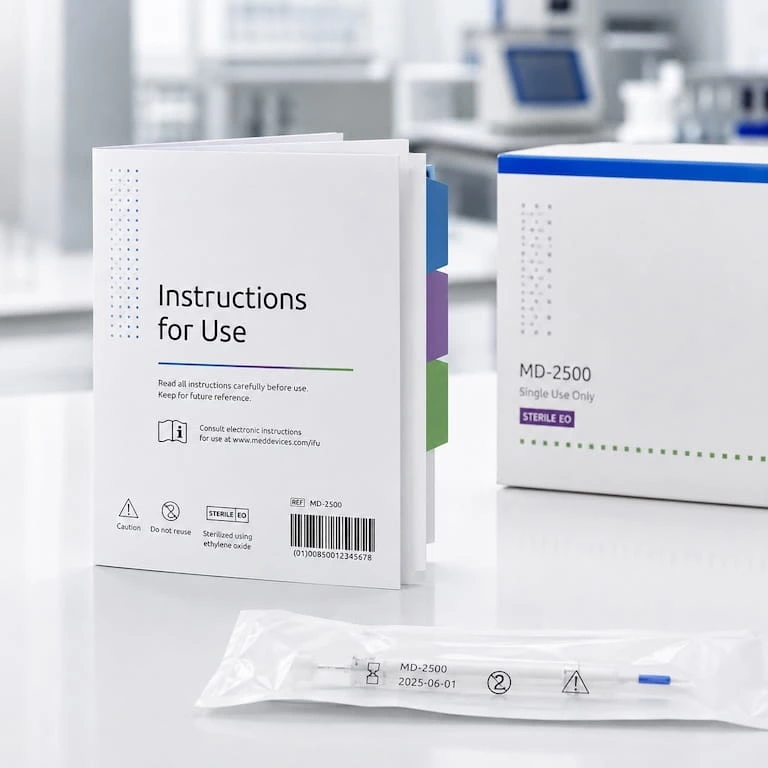
What Is an IFU, and Why Does IFU Printing Matter?
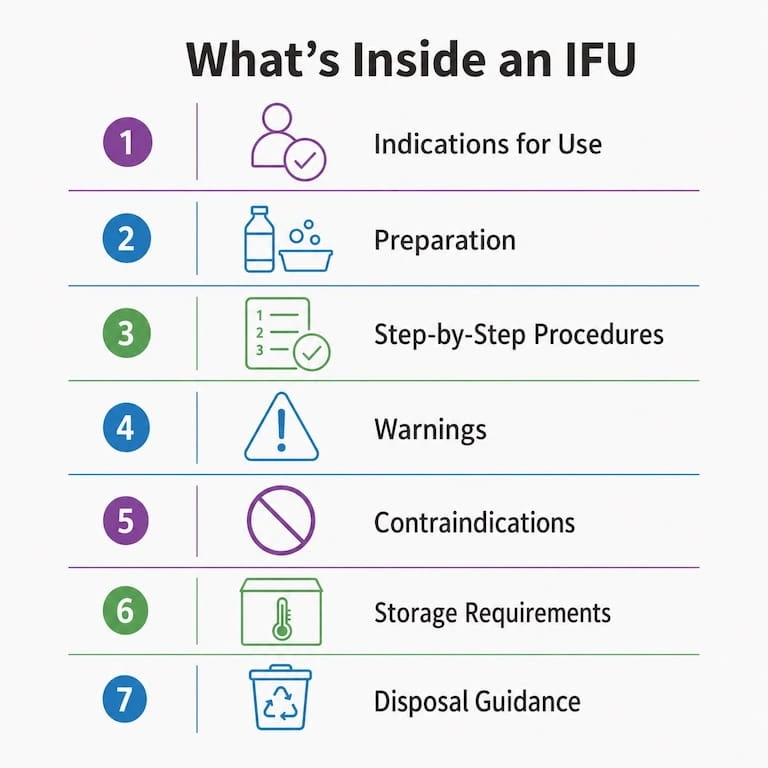
An IFU is a regulated document that tells clinicians, patients, or caregivers how to use a product safely and effectively, and printing it ensures that instruction stays available and consistent at the point of use. In healthcare, your IFU typically covers indications for use, preparation, step-by-step procedures, warnings, contraindications, storage requirements, and disposal guidance. It translates complex requirements into steps someone can actually follow under pressure. If you’re asking what an IFU is for a medical device, think of it as your single source of truth: the document that guides proper setup, use, and maintenance. It’s part of a broader documentation strategy for medical device and equipment manufacturers, one that has to hold up across every market you ship to.
Printed IFUs still matter because they work at the point of use, without power, internet access, or a device. In a clinical setting, print prevents the version drift you can run into with cached or outdated digital files, so everyone in the room is working from the same validated content. Legible, well-designed printed instructions also help you prevent misuse, dosage errors, and adverse events. When you’re weighing what an IFU needs to do for a medical device, consider how printing gives you a validated, consistent reference that’s easy to audit.
Many regulators require printed IFUs or patient leaflets in packaging, particularly for prescription drugs, implantables, single-use devices, sterile products, and emergency-use items. Even where the FDA permits electronic labeling for certain devices, best practice often still calls for a printed component for critical safety information, language access, and redundancy. You’ll want to confirm requirements for each product class and market you sell into, and document your rationale when you choose print, digital, or a hybrid approach. IFU printing helps you keep every IFU in the field aligned with your approved content.
How Do You Specify and Control Quality for IFU Printing?
You control IFU quality through a combination of document version control, structured proofing, and validated print processes tied to your QMS. Start with a controlled document management system: unique document IDs, effective dates, and a complete change history for every revision. Use two-person proofreading with structured checklists, redline comparisons, and barcode or QR verification to confirm every printed piece matches your approved master. Keep traceability from the final approved PDF all the way to the printed lot, using job tickets, item codes, and production labels.
Choose your materials and inks based on how and where the IFU will be used. Common options include lightweight pharmaceutical papers for inserts and outserts, cover-weight stock for booklets, and synthetic or coated materials for moisture or chemical exposure. Set legibility requirements up front: minimum font sizes, high-contrast black ink, accessible typefaces, and adequate line spacing. Plan for durability if your IFU needs to survive sterile barrier systems, autoclave or EO processing, cold-chain conditions, or repeated handling. Good IFU design balances readability with the packaging constraints you’re working within.

Your quality process should align with your QMS and hold up under audit. Validate your print workflows and equipment for repeatability, including color and density control. Run in-process inspections to confirm registration, fold accuracy, pagination, and scannable code performance, and apply sampling plans based on risk. Keep records of every check, along with certificates of conformity, material COAs, and batch trace logs. For UDI and serialization, verify code grading and readability under the lighting and surface conditions you expect in the field, in line with the FDA’s unique device identification requirements.
- Document control: unique IDs, version dates, change logs
- Proofing: dual review, redline comparison, barcode/QR verification
- Traceability: from master artwork to finished lot
- Materials: pharma papers, booklet stocks, synthetics for harsh environments
- Legibility: minimum font, contrast, typeface, and spacing standards
- Validation: equipment, color density, and inspection checkpoints
- Records: COAs, certificates, sampling results, and code grades
What Design and Folding Options Work Best for IFUs?
The best format and fold depend on your content length and how much packaging space you have: inserts and outserts work well for compact, concise instructions, while IFU booklets suit longer or multilingual content. Inserts work well as single sheets or multi-panel leaflets for concise instructions. Outserts are folded leaflets glued to the outside of small cartons, so you save interior space. Booklets give you room for longer content, multiple diagrams, and multilingual sections, with options for durable covers, saddle-stitching, or perfect binding. Strong IFU design makes complex topics easy to follow while keeping every required detail intact.
Your folding choice affects both readability and packaging efficiency. Parallel, roll, and accordion folds present steps in a logical sequence. Cross and map folds condense lengthy content into a compact footprint for tight cartons or pouches. Pharmaceutical outserts with right-angle and multi-panel folds let you fit a high page count into a small size. Design your layout to open in a predictable order, and keep critical warnings visible on first unfold. When your IFU design matches your equipment and your users’ needs, the instructions stay intuitive even under pressure.
If you’re producing multilingual IFUs, use a consistent grid, shared icons, and harmonized pagination. Label each language clearly, and repeat visual cues across sections so nothing gets lost in translation, literally. Keep your figure numbering consistent to avoid confusion. If space is tight, use modular designs that reuse diagrams with language-specific captions. Make sure every language meets your minimum font and contrast guidelines, and manage hyphenation and line breaks so your layout doesn’t shift between languages.
| Format | Best For | Considerations |
|---|---|---|
| Insert | Concise instructions and quick-reference steps | Keep fonts readable at small fold sizes |
| Outsert | Small cartons with limited interior space | Use precise folds and glue for secure attachment |
| Booklet | Extensive content, diagrams, and multiple languages | Choose binding and cover weight for durability |
How Can You Streamline Production and Reduce IFU Printing Costs?
You reduce IFU printing costs primarily through on-demand, distributed production, printing only what you need, close to where you need it. Print only what you need, when you need it, for each build, region, or lot, and use near-site or in-region facilities to shorten lead times and shipping distances. This limits scrap after labeling updates, design changes, or regulatory revisions, and it improves your cash flow and speed to market.
Integrate your IFU production with packaging and assembly to streamline the whole operation. Align outsert dimensions, fold patterns, and booklet thickness with your cartoning and pouching equipment. Pre-bundle IFUs with device components, kits, or UDI-labeled parts to cut down on line changeovers and downtime. Coordinate your print schedule with packaging demand signals so you can keep production continuous and maintain FIFO by lot.
A turnkey production partner simplifies oversight as you scale. On-demand printing built for regulated production gives you a secure portal for file intake, so version control and approvals happen automatically. Dedicated project management coordinates your proofs, validations, and regulatory checkpoints. Look for a partner who can scale from pilot lots and clinical builds to full commercial volumes without sacrificing quality control. As your products evolve, structured change control and fast artwork updates make sure every printed IFU reflects your current approved content, so you minimize risk during lifecycle changes and market expansions.
- On-demand printing to limit obsolescence and scrap
- Distributed production for faster regional fulfillment
- Integration with kitting and packaging to cut line stops
- Secure portals for file control and audit trails
- Flexible scaling from pilots to commercial volumes
Key Takeaways
- Structured change control keeps every printed IFU aligned with your current approved content as products evolve.
- An IFU is a regulated document guiding safe, effective product use, and printed copies remain critical at the point of care.
- Quality IFU printing depends on document control, dual proofing, traceability, and validated print processes tied to your QMS.
- Format and folding choices (insert, outsert, booklet) should match your content length and packaging constraints.
- On-demand, distributed production lowers inventory, scrap, and logistics costs while speeding time to market.
Ready to bring consistency and control to your IFU printing? Talk to Mimeo about your IFU printing needs and see how on-demand, distributed production can fit your quality process.
Frequently Asked Questions
What is an IFU in medical devices?
An IFU, or Instructions for Use, is a regulated document that explains how to safely and effectively use a medical device, covering setup, procedures, warnings, and disposal.
Why do medical devices still need printed IFUs instead of digital-only instructions?
Printed IFUs work without power, internet, or a device, and they prevent the version drift that can happen with cached or outdated digital files, so every user references the same validated content.
What’s the difference between an insert, an outsert, and a booklet for IFUs?
Inserts are single sheets or leaflets for concise instructions, outserts are folded leaflets glued to the outside of small cartons, and booklets suit longer, multi-language, or diagram-heavy content.
How do you maintain quality standards in IFU printing?
You maintain quality standards through document version control, dual proofreading, barcode or QR verification, and validated, auditable print processes tied to your QMS.
What you should read next

Brent Ervin-Eickhoff
Director of Marketing
Brent Ervin-Eickhoff is a Chicago-based marketer with B2B and B2C experience spanning corporations, agencies, and non-profits, including five years of experience in print. From Volkswagen to the University of Chicago, his background is focused in crafting marketing campaigns that drive results.

 Mimeo Print
 Mimeo Digital for Participants
 Mimeo Marketplace
 PrintX
 Mimeo Photos