



 By Brent Ervin-Eickhoff
•
6 Apr 2026
•
Updated 21 Jul 2026
•
10 min read
•
Direct Mail & Print Marketing
By Brent Ervin-Eickhoff
•
6 Apr 2026
•
Updated 21 Jul 2026
•
10 min read
•
Direct Mail & Print Marketing
What Is Omnichannel Marketing?
Omnichannel marketing is a customer-centric strategy that delivers a seamless, integrated brand experience across all channels, including websites, email, mobile apps, social media, physical locations, and print.
It connects data, messaging, and customer interactions so people can move between channels without losing context. Whether a customer starts online, switches to mobile, or visits in person, the experience remains consistent and connected. Marketing and sales enablement teams use omnichannel marketing when targeting large audiences.

Key Benefits of Omnichannel Marketing
- Higher revenue: Customers who engage across multiple channels are more likely to convert and spend more over time
- Improved loyalty: Consistent experiences build trust and increase retention
- Better customer experience: Seamless transitions between channels reduce friction
- Increased efficiency: Unified data and automation improve targeting and reduce wasted spend
Impact on Marketing, Sales, and Service
- Marketing: Enables personalized messaging across every touchpoint using unified data
- Sales: Supports flexible buying journeys, such as browsing online and purchasing in store
- Customer service: Gives teams full visibility into customer history for faster, more effective support
Challenges of Omnichannel Marketing
- Data integration: Connecting systems like CRM, POS, and marketing platforms can be complex
- Technology investment: Requires tools that support real-time data and automation
- Organizational silos: Teams must align across departments to deliver a consistent experience
Omnichannel vs Multichannel Marketing
Both approaches use multiple channels, but the key difference is how those channels work together.
- Multichannel marketing uses several channels, but they operate independently
- Omnichannel marketing connects channels so data, messaging, and experiences are unified
With omnichannel, the customer journey is continuous. Interactions build on each other instead of starting over in each channel.
How to Build an Effective Omnichannel Marketing Strategy
Executing an omnichannel marketing strategy requires cross-functional alignment, connected data, and coordinated technology. Use the following framework to move from insight to orchestration to optimization. We keep the guidance practical and direct so you can act quickly.
1) Identify Customer Touchpoints and Preferences
- Map the full journey from discovery to advocacy, including search, social, website, email, SMS, mobile app, in-store visits, events, print catalogues, call center, chat, and support portals.
- Use qualitative research and analytics to understand who your customers are, what they need, and how they prefer to engage.
- Segment audiences by behavior, value, and needs. Capture intent signals (e.g., views, add-to-cart, support topics) to inform messaging and cadence.
2) Unify Data and Technology for Seamless Experiences
- Implement a CDP or data lake to consolidate first-party data from web and app analytics, CRM, POS, email, and support platforms. Ensure robust identity resolution to connect devices and sessions to a single, privacy-aware profile.
- Integrate marketing automation, content management, commerce, and service systems via APIs. Establish data contracts and common definitions for consistency.
- Adopt a real-time decision engine to trigger messages based on behavior, inventory, propensity, and business rules. Select omni channel marketing tools that integrate cleanly with your current stack.
3) Orchestrate Journeys and Content
- Design cross-channel journeys that adapt to context. For example, if a cart is abandoned on mobile, send an email with cart contents, follow with an SMS for a time-limited offer, and coordinate ads with the same creative and pricing. Mirror the offer in printed inserts or in-store signage when appropriate.
- Keep visual identity, tone, and product data aligned across channels. Use a design system and centralized content components.
- Build modular content and offers that can be dynamically composed for each channel while maintaining consistency.
- Use ABM direct mail to drive engagement.
- Extend digital journeys into physical touchpoints by incorporating printed materials for omnichannel marketing such as direct mail, inserts, or leave-behinds that reinforce the same message.
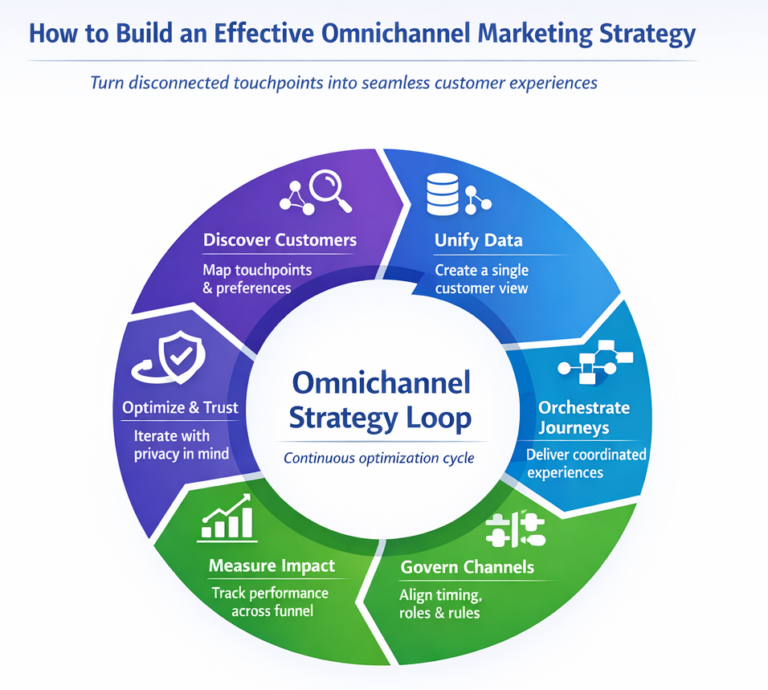
4) Enable Channel Coordination and Governance
- Define channel roles to avoid conflict (e.g., email for education, SMS for time-sensitive alerts, ads for reacquisition, direct mail for high-value offers).
- Set frequency caps, suppression logic, and prioritization rules to prevent fatigue and contradictions.
- Maintain a shared calendar for campaigns and always-on journeys. Document brand guidelines, copy frameworks, and localization rules.
- Equip customer-facing teams with the same context used by marketing so service interactions reinforce the experience.
- Direct mail and printed materials can support high-value offers, onboarding, and retention efforts, especially when coordinated with digital messaging.
5) Measure Success Through Analytics and Feedback
- Track funnel-wide KPIs: reach, engagement, conversion rate, average order value, customer acquisition cost, retention, and lifetime value.
- Use attribution models and controlled experiments to understand incremental impact. Avoid relying exclusively on last-click metrics.
- Collect qualitative insights from surveys, usability tests, reviews, and support transcripts. Feed performance data into your decisioning engine for continuous improvement.
6) Iterate with Privacy and Compliance in Mind
- Implement robust consent management and preference centers. Practice data minimization and clear opt-in/out controls.
- Lean on first-party data and consider server-side tagging to improve data quality and reliability.
- Build and maintain trust by being transparent about data use and giving customers control over frequency and channels.
Examples of Successful Omnichannel Marketing
Organizations across categories are proving that connecting data and content delivers better outcomes. The omnichannel marketing examples below illustrate repeatable patterns you can adapt to your business model. These are straightforward, practical use cases you can implement with the right omni channel marketing tools and cross-functional teamwork.
Retail and eCommerce
A national apparel retailer unified online browsing with in-store point-of-sale data to create seamless handoffs. Shoppers who viewed items online received store-level availability alerts and could reserve for pickup. Associates accessed customer preferences, so fitting room suggestions reflected prior browsing. Coordinated email and mobile push featured the specific items each customer considered, lifting conversion and average order value. Printed lookbooks and direct mail catalogs reinforce the same products and offers featured online.
Consumer Electronics
A consumer tech brand used a CDP to coordinate pre- and post-purchase journeys. Prospects who watched product demos received follow-up how-to content via email and retargeting on YouTube. After purchase, the app delivered guided setup and proactive troubleshooting. Support agents saw the same history, reducing resolution time and boosting satisfaction scores. Packaging inserts directed users to onboarding resources, tying print to digital in a clear omnichannel approach.
Financial Services
A regional bank integrated web, mobile app, branch CRM, and call center data. If a customer paused a credit card application online, the system sent an SMS reminder and offered branch appointment scheduling with a banker who had the application context. Email, ads, and in-app messages displayed consistent rates and benefits throughout the journey, improving completion rates. Statement mailers reinforced key benefits and next steps to close gaps for paper-first customers.
Healthcare
A healthcare provider aligned patient portals, appointment systems, and contact center workflows. Patients received reminders via email and text with options to confirm, reschedule, or start a telehealth session. After visits, educational content and follow-up surveys were personalized based on diagnosis and physician notes, reducing no-shows and improving adherence. Waiting room posters and mailed preparation checklists matched the digital instructions, another example of a thoughtful omnichannel strategy.
B2B SaaS
A software company connected product analytics, marketing automation, and CRM to tailor outreach during trials and onboarding. Users who reached key activation milestones received fewer promotional emails and more advanced enablement materials. Prospects who stalled saw contextual in-app guides and could initiate live chat with sales. Reps entered conversations with a complete activity timeline, accelerating deal cycles. Custom printed sales kits, onboarding guides, and event handouts provide a physical extension of digital experiences.
Omnichannel Marketing Examples You Can Borrow
Here are simple omnichannel marketing examples that teams can implement without overhauling their entire stack:
- Abandoned cart rescue: Email the exact items with availability, then follow up with SMS if unopened. Align onsite banners and retargeting creatives to match the same promotion.
- BOPIS (buy online, pick up in store): Show store-level inventory, allow reservations, and send pickup reminders. Print pickup inserts that promote accessories featured in the last email.
- Post-purchase onboarding: Combine email, in-app guidance, and printed quick-start guides or welcome kits.
- Direct mail integration: Retarget high-intent customers with personalized direct mail that mirrors abandoned cart items, reinforcing digital campaigns and increasing conversion.
- Event follow-through: Send digital recaps and reinforce with mailed sales collateral or brochures. Follow this guide to refreshing your marketing collateral before an event.
- Loyalty programs: Include printed membership cards, catalogs, or personalized offers to new customers.
These omnichannel marketing examples work because they keep data, content, and timing aligned. They are also great pilots to validate your omnichannel strategy before expanding.
Future Trends in Omnichannel Marketing
AI-Driven Personalization
AI enables real-time decision-making, helping brands deliver the right message at the right time based on customer behavior.
Evolving Technology Stacks
Flexible, API-driven systems allow teams to connect tools and scale faster without rebuilding their entire infrastructure.
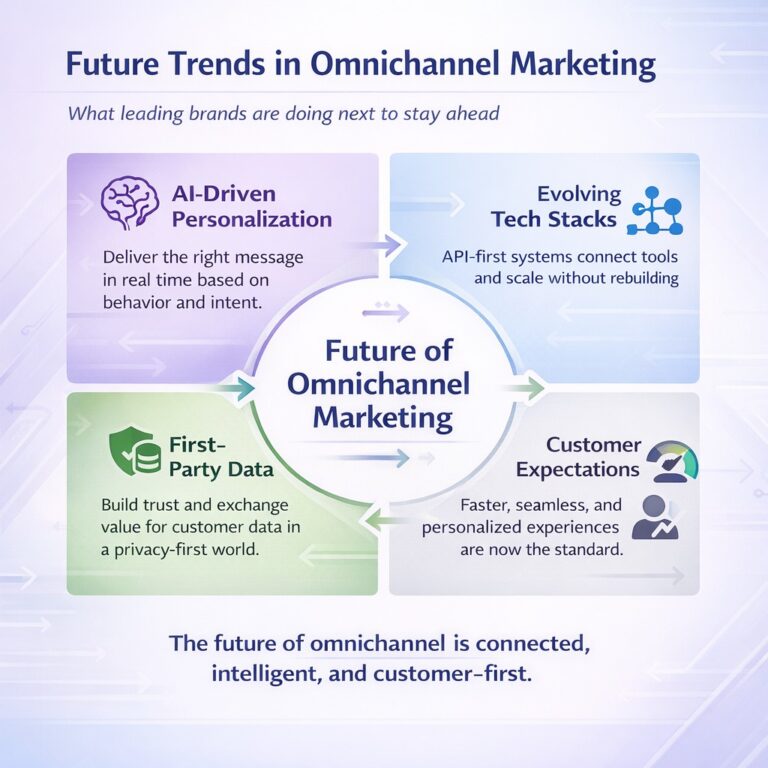
First-Party Data Strategies
As privacy expectations increase, first-party data becomes essential. Brands must build trust and offer value in exchange for customer information.
Rising Customer Expectations
Customers expect fast, seamless, and personalized experiences. Brands that reduce effort and anticipate needs will stand out.
Common Pitfalls to Avoid
- Trying to do too much at once instead of starting with a focused use case
- Investing in tools without aligning teams and processes
- Sending too many messages without coordination
- Measuring channels separately instead of looking at the full journey
- Ignoring privacy and customer preferences
How to Transition from Multichannel to Omnichannel
If your current setup is multichannel, use a staged approach to reach omnichannel maturity. The path below keeps teams focused and reduces risk while you build the foundation for a resilient omnichannel approach.
- Assess and align: Audit channels, data flows, and KPIs. Secure executive sponsorship and define a shared vision.
- Pick a pilot: Choose one journey with clear ROI potential (e.g., onboarding, replenishment) and a manageable data footprint.
- Establish the data layer: Implement identity resolution and create unified profiles. Define schema standards and consent policies.
- Connect activation: Integrate orchestration with priority channels and build modular content for reuse.
- Measure and refine: Run controlled tests, capture feedback, and iterate on rules and creative.
- Scale responsibly: Add channels and use cases, expand governance, and automate processes as you grow. Evaluate omni channel marketing tools regularly to keep your stack flexible and effective.
Omnichannel vs. Multichannel at a Glance
| Dimension | Multichannel | Omnichannel |
|---|---|---|
| Channel coordination | Channels operate independently | Channels coordinated to one journey |
| Data and identity | Fragmented by tool and team | Unified profiles with identity resolution |
| Messaging | Generic or channel-specific | Personalized and consistent across touchpoints |
| Decisioning | Batch campaigns and static rules | Real-time next-best action and dynamic content |
| Measurement | Channel metrics and last-click | Cross-funnel KPIs and incrementality |
| Customer experience | Disjointed; repeated information | Continuous; context travels with the customer |
Frequently Asked Questions
What is omnichannel marketing in simple terms?
It is a strategy that connects all customer interactions so the experience feels seamless across channels.
How is omnichannel different from multichannel?
Multichannel uses multiple channels, but omnichannel connects them into one unified experience.
Do you need a CDP for omnichannel marketing?
Not always, but you need a way to unify and activate customer data across channels.
Which channels matter most?
Start with the channels your customers already use, then expand as your strategy grows.
The Bottom Line
An omnichannel marketing strategy connects data, messaging, and customer interactions into one seamless experience. When done well, it increases engagement, improves conversion rates, and builds long-term loyalty.
Start with one clear use case, unify your data, and align your channels. Then measure results and expand your strategy over time.
Bring your omnichannel strategy to life with consistent, high-quality print that connects seamlessly with your digital channels. With Mimeo, you can create, manage, and deliver branded materials for marketing and sales teams that support every stage of the customer journey. Request your free demo to bring your omnichannel strategy to life.

Brent Ervin-Eickhoff
Director of Marketing
Brent Ervin-Eickhoff is a Chicago-based marketer with B2B and B2C experience spanning corporations, agencies, and non-profits, including five years of experience in print. From Volkswagen to the University of Chicago, his background is focused in crafting marketing campaigns that drive results.

 Mimeo Print
 Mimeo Digital for Participants
 Mimeo Marketplace
 PrintX
 Mimeo Photos