



 By Mia Conway
•
24 Apr 2026
•
Updated 21 Jul 2026
•
7 min read
•
Design & Print Production
By Mia Conway
•
24 Apr 2026
•
Updated 21 Jul 2026
•
7 min read
•
Design & Print Production
If you’re wondering how many conference programs to print, the answer comes down to balancing attendee needs with cost control. Print too few and people miss key information. Print too many and you waste budget and materials.
For event teams managing conferences and large-scale logistics, getting print quantities right is just one piece of the puzzle. Working with a partner that specializes in event printing services can help ensure your materials are produced accurately and delivered where they need to be, on time.
This guide breaks down how to estimate the right quantity, what factors matter most, and how to avoid overordering while still delivering a strong attendee experience.
Quick Answer: How Many Conference Programs Should You Print?
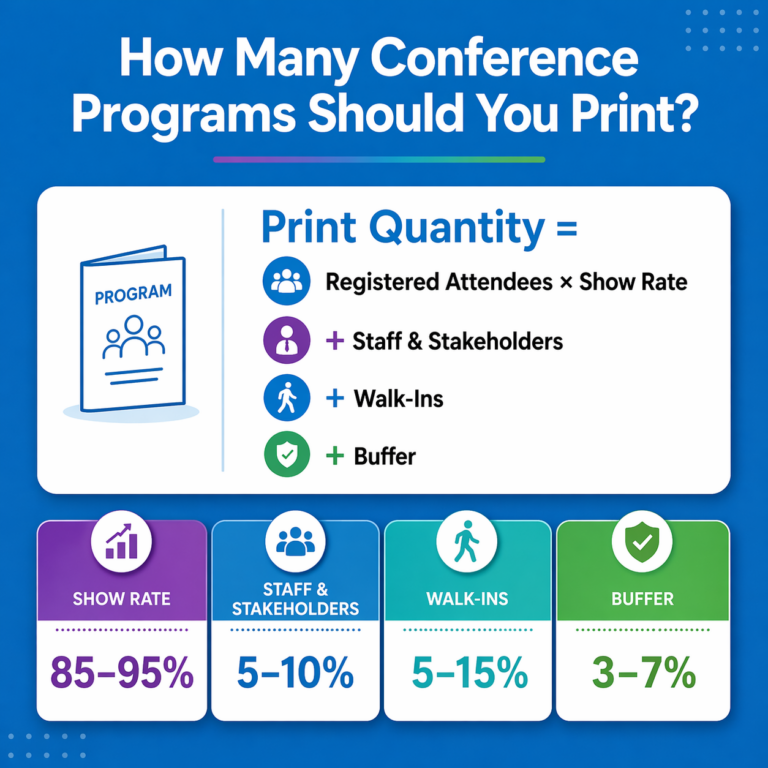
A common question planners ask is how many conference programs to print, and the answer usually comes down to a simple formula based on attendance, staff, and a small buffer.
Print quantity = (Registered attendees × show rate) + staff and stakeholders + expected walk-ins + buffer
Most events land within:
- 85 to 95 percent show rate
- 5 to 10 percent for staff and stakeholders
- 5 to 15 percent walk-ins depending on event type
- 3 to 7 percent buffer
This gives you a realistic range without overcommitting.
Why Printed Programs Still Matter
Even with event apps, printed programs remain essential for many attendees.
They help people:
- Navigate schedules quickly without relying on Wi-Fi
- Find sessions, rooms, and exhibitors faster
- Reference content during and after the event
- Engage with sponsors through high-visibility placements
Printed conference materials also reduce pressure on staff and information desks. When attendees can find answers on their own, your event runs more smoothly.
Key Factors That Impact Print Quantity
1. Expected Attendance
Start with confirmed registrations. Then adjust for:
- Historical no-show rates
- Same-day registrations
- Staff, speakers, sponsors, and VIPs
Large conferences tend to be more predictable. Smaller or community events often see more walk-ins. You can reduce event waste by accurately calculating the number of potential attendees.
2. Event Complexity
The more complex your event, the more valuable printed programs become.
You may need higher quantities if your event includes:
- Multiple days
- Concurrent sessions
- Workshops or offsite activities
- Frequent schedule changes
Complex events drive higher usage.
3. Audience Preferences
Different audiences rely on print differently.
Print usage is typically higher for:
- Associations and nonprofits
- Academic or government audiences
- International attendees
If your event app adoption is below 70 percent, plan for broader print distribution and extra printed materials for conferences and large-scale events.
Choosing Program Formats and Supporting Materials
Mixing formats can satisfy different preferences while controlling costs. Selecting the right combination increases usefulness without overspending. When planning conference materials printing, match formats to how attendees consume information on-site.
- Program formats:
- Full booklets: Include daily schedules, maps, speaker bios, and sponsor ads for a complete reference.
- Brochures or tri-folds: Offer at-a-glance agendas and essential information in a compact format.
- Single-page quick guides: Pocket- or lanyard-size schedules for rapid reference.
- Track cards: Session listings by theme or room for quick scanning.
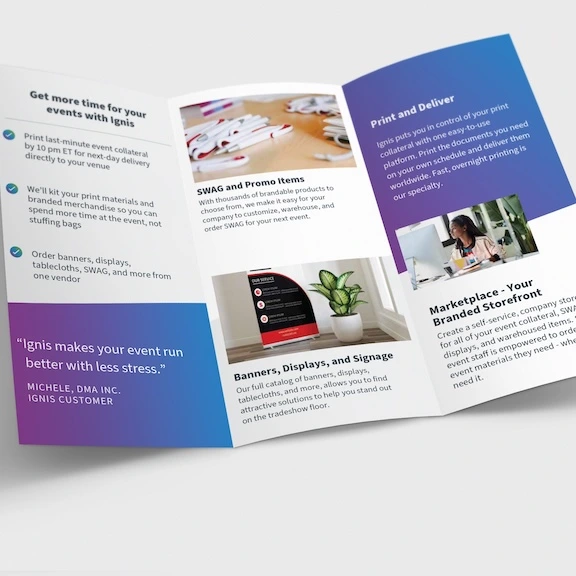
- Supplementary handouts: Consider daily agendas, speaker bio inserts for marquee sessions, venue maps and exhibit floor plans, and sponsor or exhibitor directories. These targeted pieces boost clarity where it matters most and help right-size conference handout quantities.
- Display signage for conferences and events: Large-format signs reinforce room names and schedules. Quick-print inserts, table tents, or QR codes help communicate last-minute changes and connect attendees to the latest digital schedule.
Step-by-Step: How to Estimate Program Quantity
Follow this process to build a realistic estimate:
Step 1: Start with registrations
Apply your expected show rate, usually 85 to 95 percent.
Step 2: Add staff and stakeholders
Include speakers, volunteers, sponsors, and media. Typically 5 to 10 percent.
Step 3: Account for walk-ins
Add 5 to 15 percent depending on event type.
Step 4: Adjust for format mix
If you offer both booklets and quick guides, reduce booklet volume and increase lighter materials.
Step 5: Add a buffer
Include 3 to 7 percent for damaged or last-minute needs.
Example Calculation
For 1,000 registrants:
- 90 percent show rate = 900 attendees
- 80 staff and stakeholders
- 8 percent walk-ins = 72
- 5 percent buffer on attendees = 45
Total: 1,097 programs
How to Avoid Overordering
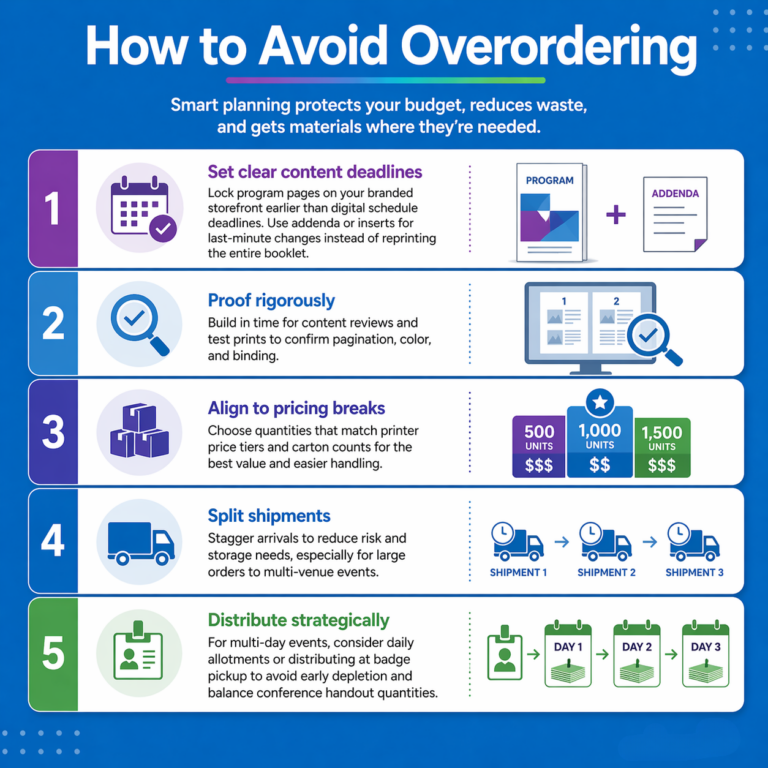
Thoughtful planning ensures accuracy, protects your budget, and keeps materials flowing to the right places. These tips align with best practices for conference printing and help you optimise cost and convenience.
- Set clear content deadlines: Lock program pages on your branded storefront earlier than digital schedule deadlines. Use addenda or inserts for last-minute changes instead of reprinting the entire booklet.
- Proof rigorously: Build in time for content reviews and test prints to confirm pagination, color, and binding.
- Align to pricing breaks: Choose quantities that match printer price tiers and carton counts for the best value and easier handling.
- Split shipments: Stagger arrivals to reduce risk and storage needs, especially for large orders or multi-venue events.
- Distribute printed materials strategically: For multi-day events, consider daily allotments or distributing at badge pickup to avoid early depletion and balance conference handout quantities.
How to Handle Last-Minute Changes
Event planning 101 calls for expecting the unexpected. Build flexibility into your plan so unexpected demand doesn’t leave attendees empty-handed. A nimble approach to print conference needs keeps your event running smoothly.
- Keep a reserve: Store a small on-site buffer in unopened boxes for peak check-in times. Monitor usage daily to adjust distribution.
- Prepare for quick reprints: Maintain a final, print-ready PDF and coordinate with a local or partner provider for rush production if necessary. Choose a reliable event program printing service to turn around supplemental runs quickly.
- Use digital backups: Place QR codes on signage, registration counters, and lanyard cards to direct attendees to the latest schedule and updates if printed supplies run low.
Printing Options and Customization
Your print partner should combine speed, precision, and brand consistency with dependable delivery to venues, hotels, and offices. Align choices with the conventions of print to ensure readability and durability on-site.
- Production methods: On-demand digital printing offers fast turnarounds and precise quantities to minimize waste. When timelines and volume allow, offset printing delivers cost efficiency at scale. Look for kitting services to bundle programs with badges, lanyards, or welcome packs, plus consolidated shipping to multiple locations.
- Formats and finishes: Choose standard or custom sizes, full-color covers, and durable stocks for frequent handling. Select saddle-stitching for 8–64 pages, perfect binding for thicker guides, and UV or matte coatings for a premium finish. Consider sponsor ad pages, tabbed dividers for tracks, and fold-out maps for at-a-glance orientation.
- Accessibility and readability: Use clear section headers, high-contrast typography, and accessible fonts to support quick scanning and inclusive design. These decisions are central to effective conference materials printing.
Timeline Planning
Work backward from your event date.
Typical timing:
- 1 to 3 business days for digital printing after approval
- Additional time for binding or large orders
- Delivery 1 to 2 days before the event
Always build in time for revisions and unexpected changes.
Final Takeaway
The right number of conference programs comes from a clear formula, realistic assumptions, and smart format choices.
Start with attendance. Add stakeholders and walk-ins. Include a small buffer. Then optimize with a mix of formats.
When you plan carefully, you reduce waste, control costs, and make sure every attendee has what they need.
Take the guesswork out of how many conference programs to print.
With Mimeo, you can right-size your order, choose the best format mix, and ship materials directly to your venue with full visibility along the way. Get started today for conference program printing.
Frequently Asked Questions
How many conference programs should you print?
Most events should print programs based on this formula: confirmed attendees × show rate, plus staff, expected walk-ins, and a small buffer. This typically results in 90 to 110 percent of expected attendance.
What happens if you print too few conference programs?
Printing too few programs can create confusion for attendees, increase pressure on staff, and reduce engagement with sessions and sponsors. It can also impact the overall event experience.
Is it better to print fewer programs and rely on digital?
A hybrid approach works best. Many attendees still prefer printed programs for quick reference, especially at complex or multi-day events. Digital tools are helpful, but they should support, not replace, print.
How can you reduce conference program waste?
You can reduce waste by using historical attendance data, printing a mix of formats, distributing materials at check-in, and avoiding large upfront overprints.
What you should read next

Mia Conway
Director of Customer Success
Mia Conway is Director of Customer Success at Mimeo, with nearly a decade of experience supporting the company's customers and a background in account management and production spanning brands like Calvin Klein. She specializes in understanding what customers actually need (not just what they ask for) and turning that insight into smoother, more reliable print programs. Her posts help businesses navigate the practical side of ordering, managing, and distributing printed materials.

 Mimeo Print
 Mimeo Digital for Participants
 Mimeo Marketplace
 PrintX
 Mimeo Photos