




 By Paul Arnold
•
16 Jan 2026
•
Updated 21 Jul 2026
•
6 min read
•
Digital & Content Distribution
By Paul Arnold
•
16 Jan 2026
•
Updated 21 Jul 2026
•
6 min read
•
Digital & Content Distribution
A modern print portal gives organizations a better way to manage print without slowing teams down. Instead of relying on email threads, shared drives, or inconsistent vendor processes, a custom online portal centralizes how print is managed, approved, and ordered across the business.
This article explains what a print portal is, how web to print portals work, and why more organizations are adopting them to support consistent branding, simplify ordering, and scale print operations efficiently. If your corporate teams managing print workflows and brand materials still struggle with outdated files, manual approvals, or fragmented print ordering, this guide shows how a smarter portal approach can help.

What is a print portal and why does it matter for corporate print?
A print portal is a private online portal that allows organizations to manage and order approved print materials in one centralized system. Instead of emailing files or coordinating with multiple vendors, teams use a single print portal to access templates, customize approved designs, and place an order through a structured, web-based experience.
A print portal for corporate teams matters because print still plays a critical role in how organizations communicate. From internal training documents to customer-facing collateral, print supports clarity, credibility, and engagement in ways digital channels alone often cannot.

Without a portal, print requests are often handled manually. Teams send emails to a printer, search for files, or recreate materials from scratch. A print portal replaces that inefficiency with a repeatable system that supports corporate print at scale while reducing errors and delays.
How do web to print portals work for modern print ordering?
Web to print portals combine traditional print production with a modern online platform. Users log into a portal, browse approved items, customize where allowed, and move through a guided ordering process.
Behind the scenes, files are already set up as print-ready assets. Approval rules, permissions, and pricing are built into the system. This allows teams to manage and order materials without needing design expertise or constant oversight from marketing.
Why are print portals essential for brand consistency and control?
Brand consistency becomes difficult when teams operate independently. Different versions of logos, outdated layouts, or unauthorized changes can easily slip into print when processes are loose. When customers don’t recognize your brand, your business suffers.
A print portal protects the brand by centralizing approved assets and enforcing consistent branding. Templates lock key design elements while allowing limited personalization such as contact information. This ensures every printed piece reflects the same standards, regardless of who orders it.
What types of print materials belong in a print portal?
Most organizations start with high-volume, high-impact items. These often include business cards, letterheads, brochures, flyers, signage, and other core print materials.
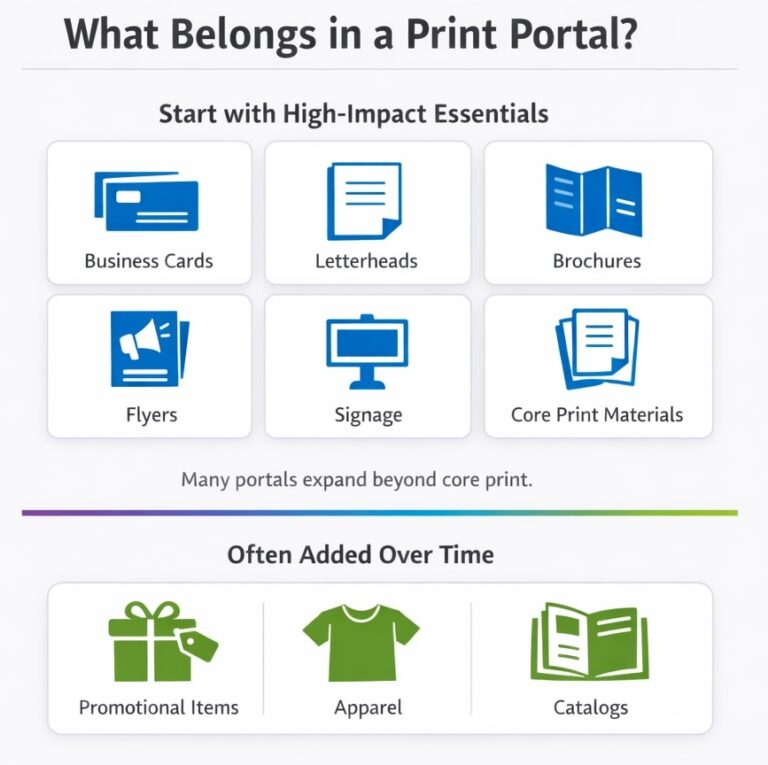
Some portals also support promotional items, apparel, and catalogs. The goal is not to include everything at once, but to focus on material needs that come up repeatedly. Over time, additional items can be added as the portal evolves.
How does a print portal simplify print ordering for teams?
Ordering print becomes easier when teams no longer need to ask how to do it. A print portal provides a clear, intuitive path from selection to checkout.
Users choose an item, customize approved fields, and place an order directly in the system. The ordering process removes ambiguity and reduces back and forth. This helps teams save time while maintaining accuracy and compliance.
How does a print portal work step by step?
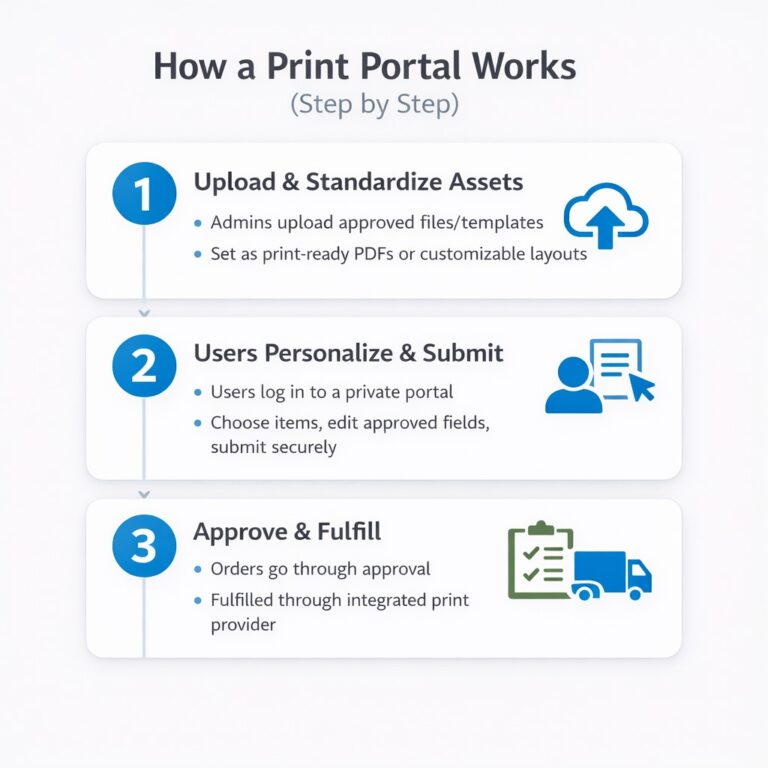
A print portal follows a consistent workflow that removes friction from print ordering.
- First, administrators upload approved files or design templates into the portal. These assets are set up as print-ready pdf files or customizable layouts that follow brand guidelines.
- Next, users log into the portal through a private online interface. They select the materials they need, personalize approved fields, and submit the order securely.
- Finally, orders move through approval if required and are fulfilled through an integrated print provider. The entire workflow is automated, repeatable, and easy to manage.
What role do templates play in a successful print portal?
Templates are essential to scalability. A single template can support hundreds of variations without introducing risk.
Design templates ensure every item stays on-brand while still allowing customization where it makes sense. This approach supports personalization without compromising layout, typography, or brand consistency.
Templates also reduce dependency on designers for routine updates. Teams can respond faster to new design needs without creating net new files every time.
How can organizations centralize print without losing flexibility?
Centralizing print does not mean restricting teams. A portal can be customized to match how the organization works and used to manage print without a dedicated print team.
A corporate portal may allow certain users to approve orders while others only place them. Permissions make it easy to delegate responsibility without losing oversight. The portal can be customized by role, region, or department to support different use cases.
Platforms like Mimeo Marketplace support this balance by centralizing print while remaining flexible enough to adapt to real workflows.
What should you look for in a print provider and online platform?
The quality of the platform matters as much as the quality of the print. A strong online platform should be web-based, intuitive, and easy to use from desktop devices.
Look for features that simplify onboarding, support approval, and improve usability. The platform should integrate smoothly into existing systems and allow teams to manage and order materials without friction.
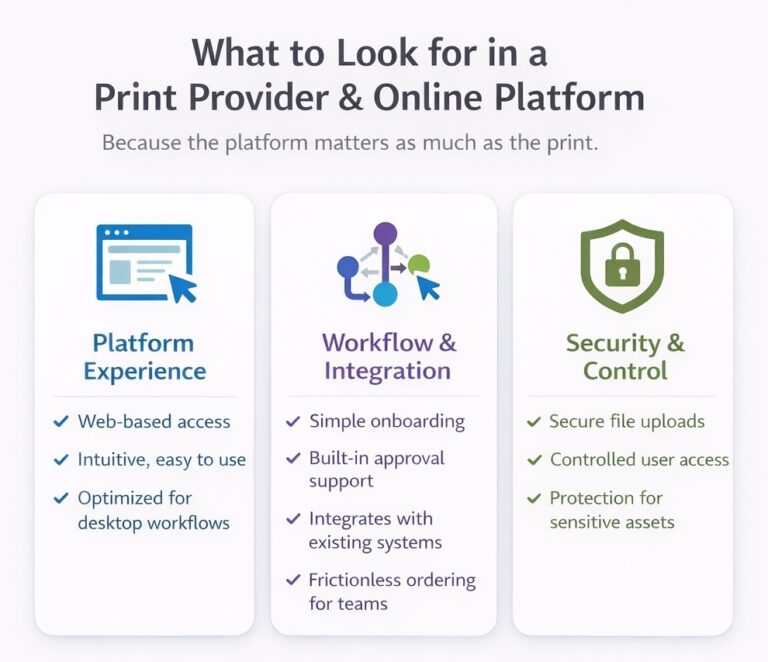
Security is also important. Files should be uploaded securely and access should be controlled to protect sensitive assets.
How does a print portal support onboarding and productivity?
Onboarding new employees with print materials often requires multiple printed assets, from training guides to branded collateral. A print portal makes these materials immediately accessible to new team members.
Instead of requesting files or waiting for approvals, new hires can access pre-approved materials on demand. This improves employee productivity in the workplace and helps teams feel equipped from day one.
As organizations grow, portals scale naturally. New products, regions, or suppliers can be added without changing the underlying system.
When does it make sense to request a demo?
If print is still handled through email, one-time requests, or manual approvals, it is worth exploring a portal. A demo helps teams see how print can be streamlined in practice.
Sign up today to explore Mimeo’s print portal solution.
How does Mimeo Marketplace support modern print portals?
Mimeo Marketplace for corporate teams provides a custom online environment where organizations can centralize print ordering without building their own infrastructure. It supports on-demand print, consistent branding, and flexible ordering through a single portal.
Rather than acting as a basic print shop, Marketplace helps organizations streamline and simplify how print is managed across teams. It is designed to support ongoing print needs, not just one-time projects.
Key takeaways to remember:
- A print portal centralizes print and simplifies ordering
- Web to print portals support scalability and brand control
- Templates make customization safe and repeatable
- A corporate portal improves onboarding and productivity
- The right online platform supports seamless, on-demand print

Paul Arnold
VP of Customer Success
Paul Arnold is VP of Customer Success at Mimeo, where he's spent over 13 years working directly with customers: first in account management and enterprise sales, and now leading the teams that support them. Having managed relationships with Fortune-level companies through every stage of the print buying cycle, he knows firsthand where document programs succeed and where they break down. His posts help businesses get more value from their print operations, from onboarding through long-term growth.

 Mimeo Print
 Mimeo Digital for Participants
 Mimeo Marketplace
 PrintX
 Mimeo Photos