




 By Ethan Cohen
•
10 Apr 2026
•
Updated 6 Oct 2026
•
10 min read
•
Industry Applications
By Ethan Cohen
•
10 Apr 2026
•
Updated 6 Oct 2026
•
10 min read
•
Industry Applications
Association onboarding shapes the member experience from day one. A clear, welcoming, and structured approach helps new members quickly see value, connect with peers, and take advantage of benefits that matter to them.
This guide shares practical ways to design a member onboarding process that boosts retention, drives engagement, and scales with technology while still feeling personal and human. As a trusted partner to marketing teams and program leaders, we focus on onboarding best practices that make new member onboarding smooth, measurable, and repeatable.

Why a Structured Onboarding Process Matters
Association onboarding and member engagement programs do more than greet new members; they influence whether they renew. Members who understand how to get value in their first 90 days are far more likely to stay. When you spotlight quick wins, like setting up a profile, accessing a member directory, registering for a webinar, or redeeming a discount, they gain momentum and form habits that lead to long term participation.
It’s also a catalyst for community. Early introductions to peer groups, mentors, and special interest communities help members find their place. Engagement in forums, committees, chapters, or local meetups creates a sense of belonging, sparks contributions, and builds relationships that tie members to your organization. This is the heart of effective new member onboarding: helping people feel connected fast.
Over time, strong association onboarding compounds benefits. Informed members use programs, provide feedback, and act as advocates. Proactive education reduces support tickets by answering common questions before they arise. Most importantly, a repeatable member onboarding process ensures every new member receives a consistent, high quality experience that reflects your brand promise. Increasing member engagement makes it more likely that members renew year over year.
Building a Comprehensive Welcome Package
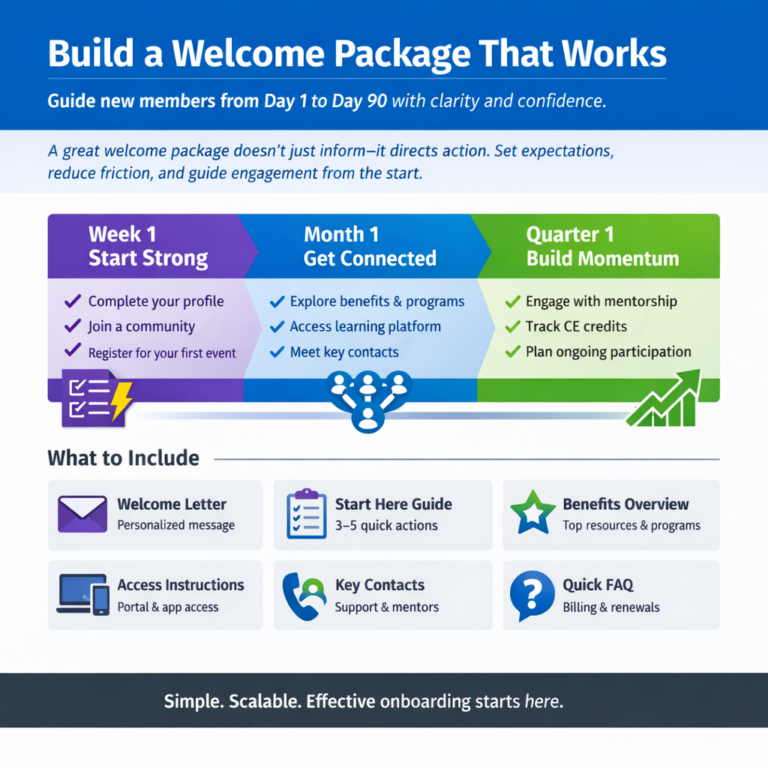
A standout welcome kit equips new members with essentials and points them to their next steps for the first 30, 60, and 90 days. Whether you deliver it digitally, physically, or as a hybrid, focus on clarity, brevity, and clear calls to action. A custom membership welcome kit for associations is one of the simplest onboarding best practices to implement and scale.
Core elements to include:
- Personalized welcome letter from leadership
- A “start here” guide with three to five immediate actions (complete profile, join a community, register for an event)
- Benefits overview with links to top resources and programs
- An onboarding timeline outlining what to expect in week 1, month 1, and quarter 1
- Access instructions for the member portal, learning platform, and mobile app
- Key contacts for member services, chapter leaders, and mentorship coordinators
- A concise FAQ covering billing, logins, CE credits, and renewal
Tailor welcome packages by member type so people see relevant opportunities first:
- Students: career resources, mentorship sign ups, scholarship deadlines, and internship opportunities
- Early career professionals: certification pathways, training, and networking events
- Executives: policy updates, thought leadership, executive roundtables, and advisory groups
- Vendors and partners: sponsorship options, exhibitor guides, and compliance policies
Elevate the experience with digital extras. Embed short video walkthroughs of the portal, publish a calendar of upcoming events with one click calendar invites, and provide a downloadable onboarding checklist. A lightweight microsite or hub for new members can centralize resources, track progress, and keep the journey engaging and easy to follow. These are key steps that strengthen new member onboarding without adding complexity for staff.
Using Technology to Streamline Onboarding
Member management software is the backbone of scalable onboarding. Use your Association Management System (AMS) or Customer Relationship Management (CRM) platform to automate welcome sequences, assign tasks, and trigger reminders based on real member activity. Segment by type, industry, region, and interests to deliver content that feels personal without adding manual work for staff.
Automated communication ensures consistency and reduces friction. A proven cadence might include:
- Immediate email with login details, portal access, and a short “start here” guide
- Day 3 email that highlights top benefits and quick wins
- Week 2 direct mail invitation for new association members to join a community, mentorship program, or chapter
- Day 30 check in asking about progress, interests, and preferences
Use conditional logic to adjust outreach. Members who attend orientation or complete their profile can receive advanced recommendations, while those who have not engaged get reminders and simplified next steps. This adaptive flow is a cornerstone of onboarding best practices for association onboarding and member onboarding.
Make orientation accessible and interactive with online platforms. Host live virtual sessions with breakout rooms for networking and record them for on demand viewing. Offer 10 to 15 minute micro orientations focused on high interest topics such as certification, advocacy, volunteer pathways, or upcoming events. Enable single sign on so members can join sessions and access materials without extra steps. Use polls and live Q and A to gather insights and keep sessions lively.
Engaging New Members from Day One
Personalization signals that you understand each member’s goals. Use data from sign up forms to reference interests and recommend content. Introduce a named staff contact or ambassador and offer a brief welcome call. Share the top three steps tailored to their segment and link to a self assessment that maps them to the most valuable programs. These moves make your member onboarding process feel thoughtful and efficient.
Create early excitement with exclusive experiences. Consider a new member orientation series, a quarterly welcome town hall with leadership, or invite only roundtables by industry segment. Provide access to a new member resource hub for the first 90 days, featuring curated content such as toolkits, discount codes, and recordings designed for newcomers.
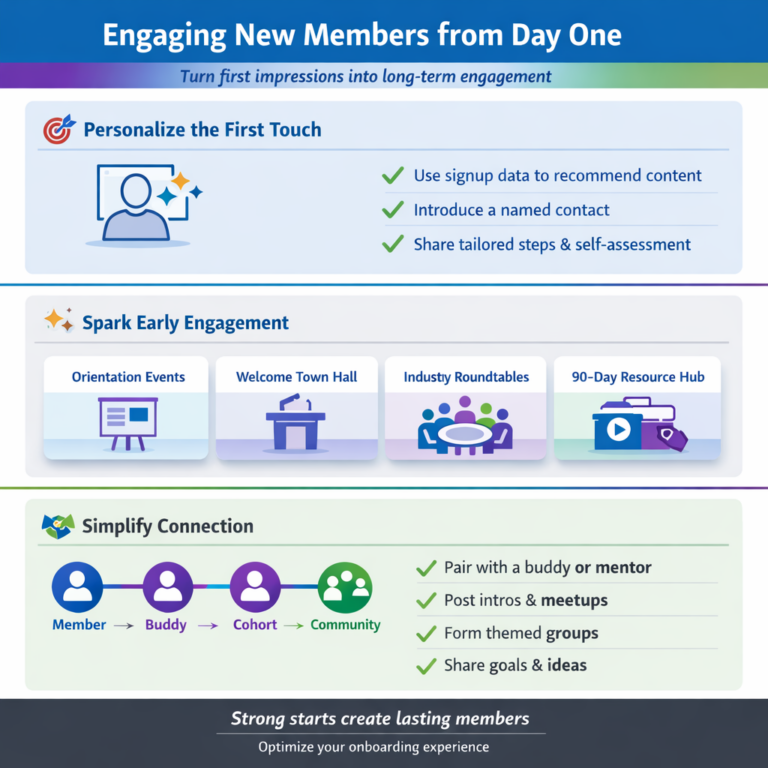
Make networking easy and low pressure. Pair members with a buddy or mentor, post introductions in your community, and highlight upcoming chapter meetups. Form thematic cohorts, such as first time attendees or early career professionals, and give them prompts like sharing a quarterly goal, posing a question of the week, or co creating a resource list. These early touchpoints build relationships that lead to deeper involvement in association onboarding and beyond.
Collecting and Acting on Feedback
Gather feedback early and often to improve onboarding in real time. Share a short survey after the first week to measure clarity, ease of access, and perceived value. Add pulse checks at day 30 and day 60 to track whether members use key benefits. Supplement surveys with quick polls in your community platform and optional 10 minute interviews with a small sample of new members each month.
Translate insights into concrete changes. If members struggle with login or navigation, create a 60 second tutorial and add it to the welcome email. If events feel overwhelming, provide a curated first timer agenda. When certain segments under engage, adjust your recommendations and update automated sequences to better match their needs. Iteration is one of the most reliable onboarding best practices for strengthening new member onboarding.
Close the loop to build trust. Communicate what you changed and why: “You asked for shorter orientation sessions; we added micro orientations you can watch anytime.” Share a quarterly “You said, we did” update to highlight improvements and encourage continued input.
Measuring Onboarding Success
Set clear KPIs to monitor progress and guide decisions. Track both leading and lagging indicators:
| Metric Type | Example KPIs | Why It Matters |
|---|---|---|
| Leading indicators | Welcome email open and click-through rates; profile completion in first 14 days; first event attendance; community sign-ups; onboarding checklist completion | Signal early momentum and identify friction points before they impact retention |
| Lagging indicators | 90-day engagement score; satisfaction ratings; CSAT and Net Promoter Score; year-one renewal rate for newly onboarded members | Reflect overall program effectiveness and long-term outcomes |
To support renewal, consider membership renewal letter printing for associations as part of your day 90 outreach. Use tools that centralize data for easier analysis. Your AMS or CRM should capture member actions and segment-level performance. Pair it with marketing automation to measure campaign analytics and with survey platforms for CSAT and NPS. Implement dashboards that visualize onboarding milestones so staff can proactively support members who stall.
Continuously refine your approach based on insights. If profile completion is low, streamline the form and defer nonessential fields. If first event attendance lags, include calendar invites and schedule reminders at optimal times. When predictors of renewal dip, deploy outreach from ambassadors to at-risk members. Treat your member onboarding process as a living program: test, measure, and iterate to steadily increase member value and retention.
Putting It All Together: A Sample 90 Day Onboarding Flow
Use this sample timeline to guide your planning. Adjust by segment and channel mix. These steps align with onboarding best practices and are easy to customize for association onboarding at any scale.
- Day 0 to 1: Send a welcome email with login details, a two minute portal walkthrough, and a three step “start here” checklist. Send via membership drive printing for new member recruitment or link digitally to the welcome package.
- Day 3: Share a benefits snapshot tailored to the member segment. Include direct links to one learning resource, one community, and one event.
- Week 2: Invite the member to a live orientation or micro orientations by topic. Offer a buddy or mentor match and encourage a short profile completion.
- Day 30: Check in with a brief survey and recommend next steps based on what they have completed. Feature a chapter event or cohort activity.
- Day 45 to 60: Highlight deeper programs such as certification, volunteering, and policy committees. Share a “new member wins” post to inspire participation.
- Day 90: Celebrate progress with a summary of completed milestones and suggest ongoing engagement pathways. Request feedback to fuel improvements.
Tips to Scale Without Losing the Personal Touch
- Start small with a core sequence, then layer in segment specific variations
- Automate routine steps, but assign humans to high impact moments like welcome calls and community introductions
- Use dynamic content blocks to tailor mailers and landing pages by interests
- Create reusable micro videos for common tasks and FAQs
- Empower ambassadors with templates and talking points for consistent outreach
- Review analytics monthly and run A B tests on subject lines, calls to action, and send times
These simple moves keep member onboarding efficient while preserving the human touch that makes new member onboarding memorable.
Key Takeaways
- Design association onboarding to deliver quick wins in the first 90 days to build momentum and improve renewal likelihood
- Center community by connecting members to peers, mentors, and segments that fit their goals
- Use your AMS or CRM and marketing automation to scale personalization and track results across your member onboarding process
- Tailor welcome packages and content by member type to keep recommendations relevant
- Gather feedback early, act on it quickly, and close the loop with clear communication, core onboarding best practices that drive satisfaction
- Measure leading and lagging indicators and iterate continuously to strengthen outcomes in association onboarding and new member onboarding
When onboarding is intentional, consistent, and responsive, new members feel supported from the start. That foundation drives long term engagement, advocacy, and renewal. If you need help delivering welcome kits, printing quick start guides, or building digital hubs that keep information organized and accessible, lean on partners who make complex tasks simple so you can focus on what matters most: serving your members.
Ready to create an onboarding experience that drives engagement from day one? Mimeo helps you deliver welcome kits, print materials, and digital resources that make every new member feel supported. Get started with association onboarding materials.
What you should read next
Ethan Cohen
Account Executive
Ethan Cohen is an Account Executive at Mimeo, having built his career here from Sales Development Representative to Team Lead and now full-cycle sales. He brings a strategic, relationship-driven approach to turning market opportunities into long-term client partnerships, including with nonprofits and associations looking to stretch their print and content budgets further. His posts help businesses think through how to build strong, sustainable sales processes and get real value from their vendor relationships.

 Mimeo Print
 Mimeo Digital for Participants
 Mimeo Marketplace
 PrintX
 Mimeo Photos