



 By Alex Otte
•
9 Oct 2026
•
13 min read
•
Industry Applications
By Alex Otte
•
9 Oct 2026
•
13 min read
•
Industry Applications
To write an end-of-year donor letter for your association, open with gratitude or a specific result, make a clear ask by the second paragraph, and support it with one member story and one or two numbers. Explain what the gift funds beyond dues, match your tax language to whether the association or its foundation is asking, and close with a deadline and a P.S.
Timing works in your favor. December accounts for roughly 40% of the average nonprofit’s online one-time revenue, according to year-end giving statistics from Neon One, and members are naturally reflecting on what their profession or industry accomplished over the past twelve months. A clear, personal letter connects that reflection to a specific need and an easy way to help.
This guide covers what makes association fundraising different, how to plan and write your letter, sample language you can adapt, and how to thank donors so they come back next year. It’s part of our ongoing resources on print and mail solutions for associations.
How Is an Association Donor Letter Different From a Nonprofit Appeal?
Most fundraising advice is written for charities asking the general public for support. Associations face a different situation, and your letter should reflect it.
You’re asking people who already pay you. Members may wonder why their dues aren’t enough. Answer that question directly. Explain that dues keep the association running, while year-end gifts fund something specific and additional: a student scholarship, a workforce pipeline program, industry research, or relief for members facing hardship.
Frame giving as an investment in the profession. Members give because they care about the field they work in and the people entering it. Connect the ask to outcomes they recognize, such as new practitioners trained, standards advanced, or a community of peers strengthened.
Know who is actually asking. Many trade and professional associations are organized as 501(c)(6) organizations. Contributions to a 501(c)(6) are generally not deductible as charitable gifts, and under IRS rules on nondeductibility disclosures, most of these organizations must say so clearly in their fundraising solicitations. Many associations run year-end appeals through an affiliated 501(c)(3) foundation instead, where gifts typically are tax-deductible.
That distinction shapes your letter. If the foundation is asking, use its legal name, include its tax ID, and mention deductibility. If the association itself is asking, leave out tax-deductible language entirely and include the required non-deductibility statement. Confirm the exact wording with your accountant or legal counsel before anything goes out.
Remember the relationship continues. Unlike a one-time donor, a member will hear from you again about renewals, conferences, and committees. A respectful, grateful tone protects that relationship, and a strong member retention strategy makes future asks easier.
How Should You Plan Your End-of-Year Appeal?
A little planning makes the writing faster and the letter sharper. Settle three things first.
Set a specific goal. Instead of “raise more this December,” name a dollar target and tie it to a result. For example, “Raise $40,000 to fund 20 scholarships for first-year members in 2027.” A concrete goal gives your letter its central ask and makes results easy to measure afterward.
Work backward from your send date. Print letters should land in late November or early December, since holiday mail slows delivery. Follow with emails in early and mid-December, then a final reminder on December 30 or 31. Build in time for drafting, board or leadership approvals, and data pulls. Our guide to direct mail for associations walks through campaign planning in more detail.
Write for distinct groups. One letter rarely fits everyone. Common association segments include:
- Current members who have never donated
- Past donors, who should be thanked for their previous gift
- Lapsed donors, who need to hear what has changed since they last gave
- Board members, committee chairs, and volunteer leaders
- Sponsors and corporate partners
- Retired or emeritus members with deep ties to the field
Keep the core story the same across versions, and adjust the opening, gift amounts, and level of detail for each group. For guidance on print production, mailing lists, and postage, see our guide to donor appeal printing and mailing.
How Do You Write an End-of-Year Donor Letter?
Aim for one page in print and a short, scannable message in email. Follow these steps in order.
1. Open with gratitude or a specific result
Skip the windup. Your first sentence should thank the reader or share a concrete outcome. “Because of members like you, 18 students earned their certification this year” pulls readers in faster than a paragraph about your mission.
2. Make the ask by the second paragraph
State what you need and why: “Will you help us fund 20 scholarships for 2027?” Offer two or three suggested amounts, each tied to a result. If a board member or sponsor is matching gifts, say so here.
3. Show impact with one story and one or two numbers
Share a short story about a real person your association helped, such as a scholarship recipient, a new member, or a practitioner who benefited from your research. Add a quote if you have permission. Then support it with one or two plain-language figures.
4. Write to the reader, not about yourself
Use “you” more than “we.” Replace “Our foundation awarded 18 scholarships” with “Your support put 18 students on the path to certification.” This positions the member as the reason good things happen.
5. Close with a clear call to action
Restate the ask and the deadline. Give two simple ways to respond, such as a short URL or QR code and a reply envelope. Keep secondary options, like stock gifts or employer matching, brief so they don’t compete with the main ask.
6. Add a P.S.
Readers often skim to the postscript before anything else. Use it to repeat the deadline, the match, or the single most important result.
7. Include the right legal language
Use the tax statement that matches your organization, as described above. If the foundation is asking, include its legal name and tax ID. If the association is asking, include the non-deductibility notice.
What Should You Say in an Association Donor Letter?
Adapt these lines to your field, programs, and audience.
Openings:
- Because of members like you, 18 students earned their certification this year. Thank you.
- When Rosa lost her job last spring, our member relief fund helped her keep her license current while she searched for the next role.
- This year, more early-career professionals applied for our mentorship program than ever before. We had to turn half of them away.
- As a member, you know what this profession gave you. Here is your chance to pass it on.
Asks and gift amounts:
- Will you give $100, $250, or $500 to help fund 20 scholarships for 2027?
- A $150 gift covers exam fees for one first-year member.
- Our board has pledged to match every gift up to $25,000 through December 31. Please give today to double your impact.
- Your gift of $75 last year helped launch our mentorship program. Would you consider $100 this year to help it grow?
Email subject lines:
- You made 2026 a great year for our profession
- 48 hours left to double your gift
- Help the next generation enter the field
- A thank-you, and one more way to help before December 31
What Does a Good End-of-Year Donor Letter Look Like?
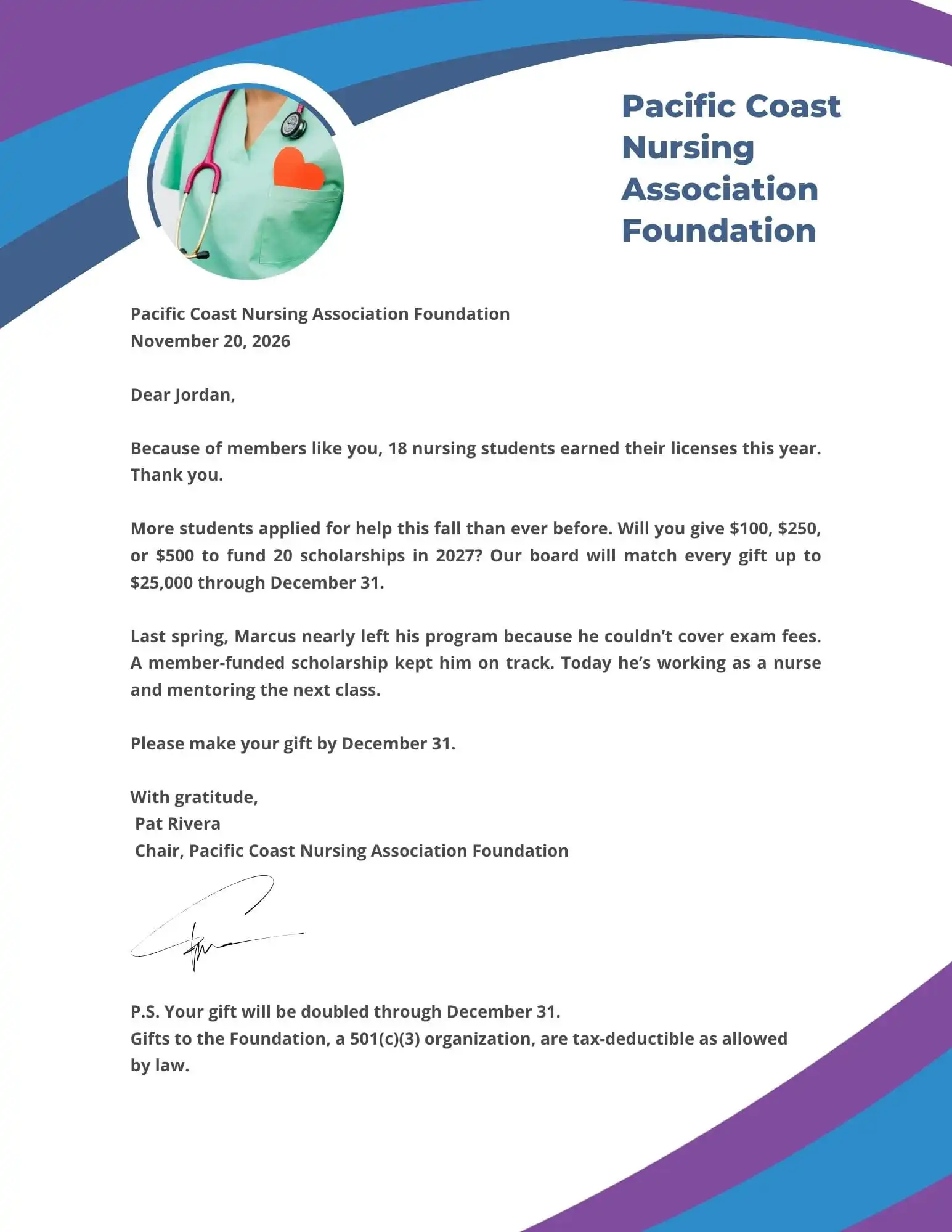
This example comes from a fictional association foundation raising scholarship funds. Use it as a model for structure and tone.
Print letter
Dear Jordan,
Because of members like you, 18 students earned their certification this year. Thank you.
More students applied for help this fall than ever before. Will you give $100, $250, or $500 to help us fund 20 scholarships in 2027? Our board will match every gift up to $25,000 through December 31.
Last spring, Marcus was weeks away from leaving his program because he couldn’t cover exam fees. A scholarship funded by members kept him on track. “I didn’t just get a check,” he told us. “I got a professional community that believed in me.” Today he’s working in the field and mentoring the next class.
Every scholarship you help fund brings a new professional into our industry. Please make your gift by December 31 at the link below or with the enclosed reply envelope.
With gratitude,
Pat Rivera, Chair, Association Foundation
P.S. Your gift will be doubled through December 31. One gift, twice the students supported.
Email version
Subject: 48 hours left to double your gift
Preview: Help fund 20 scholarships before December 31
Because of members like you, 18 students earned their certification this year. With two days left in 2026, our board will match every gift dollar for dollar, up to $25,000. Please give $100, $250, or $500 today and help the next class enter the profession.
Thank-you email
Subject: Your gift is already at work
Thank you for your year-end gift. Because of you, more students will start 2027 with exam fees covered and a mentor in their corner. We’ll share the final total and the names of this year’s recipients in January.
How Do You Choose the Right Format for Your Donor Letter?
Decide on format before design starts, since it shapes cost, timing, and response. Match each package to the segment receiving it.
- Personalized letter with a reply envelope: Best for past donors and board members. It’s the classic year-end format and makes mailing a check simple.
- Postcard reminder: Suits a mid-December follow-up to members who haven’t responded yet. Custom printed postcards are quick to read and less expensive to mail.
- Premium package: A handwritten note or one-page impact summary fits major donors and sponsors.
- Email only: Can work for members who prefer giving online, as long as print still reaches your core donors.
Mimeo can produce every piece of a year-end campaign. Our direct mail services handle printing, addressing, and delivery, so letters land on schedule. Variable data printing personalizes each letter with the member’s name, past gift, and suggested amounts.
What Mistakes Should You Avoid?
- Calling an association gift tax-deductible when it isn’t. Match your tax language to the organization doing the asking.
- Ignoring the dues question. Explain what gifts fund that membership revenue doesn’t.
- Burying the ask. If readers reach the third paragraph without knowing what you need, the letter is too slow.
- Using insider language. Acronyms and committee names mean little to many members. Describe outcomes in plain words.
- Sending one generic letter. Past donors, board members, and first-time prospects need different openings and gift amounts.
- Offering too many choices. One main ask with two response options beats a list of five ways to help.
- Skipping the P.S. It’s one of the most-read lines in any appeal.
- Mismatched donation pages. Your online form should show the same story, amounts, and deadline as the letter.
- Personalization errors. A wrong name or gift amount erodes trust. Proof merged fields carefully.
How Should You Thank Donors After the Appeal?
The thank-you matters as much as the ask, especially when the donor is also a member you’ll hear from at renewal time.
Thank quickly. Send an automated receipt for online gifts right away, and mail acknowledgments for check gifts within a week. If your foundation is a 501(c)(3), donors need a written acknowledgment for any single gift of $250 or more to claim a deduction. Review the IRS written acknowledgment requirements and build that language into your receipts.
Make it personal for key supporters. A handwritten note from the board chair or a phone call from a staff member goes a long way with first-time donors, upgraded donors, and volunteer leaders.
Show results in January. Share the final total and what it funded. Introduce scholarship recipients, report on research progress, or highlight a program that grew. Printed member newsletters, your annual meeting, and your conference are natural places to recognize donors.
Connect giving to membership. Recognize donors in your member directory or at events where appropriate, invite them to join a giving circle, and mention their support at renewal. Members who see their gifts at work are more likely to renew and give again.
Debrief while it’s fresh. Note which segments responded, which stories landed, and when gifts arrived. Those notes make next year’s letter faster to write and more effective.
Frequently Asked Questions
When should our end-of-year donor letter go out?
Mail print letters in late November or early December. Follow up by email in mid-December and send a final reminder on December 30 or 31.
Are gifts to an association tax-deductible?
It depends on how the organization is structured. Gifts to a 501(c)(6) trade or professional association generally aren’t deductible as charitable contributions. Gifts to an affiliated 501(c)(3) foundation typically are. Check with your accountant or counsel before finalizing any tax language.
Should we ask members who already pay dues?
Yes. Members are often your most committed supporters. Just explain clearly what their gift funds beyond what dues cover.
How long should the letter be?
One page in print is ideal. In email, keep paragraphs short and place the donate button near the top and again at the end.
Who should sign the letter?
Choose someone members recognize and respect, such as the board chair, foundation chair, or executive director. A scholarship recipient can also co-sign or add a short note.
Can we reuse last year’s letter?
Use it as a starting point, but refresh the story, numbers, dates, and any match details.
Ready to Mail Your Year-End Appeal?
Mimeo can print, personalize, and mail your end-of-year donor letters so they reach members before the holiday rush. Get started with Mimeo today to plan your campaign with our team.
Key Points to Remember
- Explain what year-end gifts fund beyond dues, and frame giving as an investment in the profession.
- Match your tax language to whoever is asking: the association or its foundation.
- Lead with gratitude or a result, and make the ask by the second paragraph.
- Tailor openings and gift amounts for members, past donors, lapsed donors, and leaders.
- Thank donors quickly, then show them their impact throughout the new year.
What you should read next
Alex Otte
Account Executive
Alex Otte is an Account Executive at Mimeo, where he has spent eight years across account management and sales roles, building deep expertise in how businesses buy and manage print. Based in Minneapolis, he draws on consultative selling training and a strong foundation in client communication and product demonstrations to guide customers toward solutions that actually fit their needs. He works closely with nonprofits and associations to help them make the most of tight budgets without sacrificing quality. His posts help businesses cut through the noise and make smarter print and distribution decisions.

 Mimeo Print
 Mimeo Digital for Participants
 Mimeo Marketplace
 PrintX
 Mimeo Photos