




 By Brent Ervin-Eickhoff
•
23 Feb 2026
•
Updated 29 Sep 2026
•
11 min read
•
Direct Mail & Print Marketing
By Brent Ervin-Eickhoff
•
23 Feb 2026
•
Updated 29 Sep 2026
•
11 min read
•
Direct Mail & Print Marketing
Direct mail campaigns consistently deliver strong returns for marketers who focus on strategy, measurement, and optimization. While digital channels are vital, printed mail stands out for its tactile impact, high engagement, and precise targeting. This guide outlines how to calculate direct mail ROI and direct mail return on investment, the levers that influence performance, and practical steps to improve results, so every piece you send contributes more profitably to your bottom line.
If you’re evaluating direct mail marketing ROI across channels, use this as your roadmap to make confident, data-backed decisions.
Understanding Direct Mail ROI
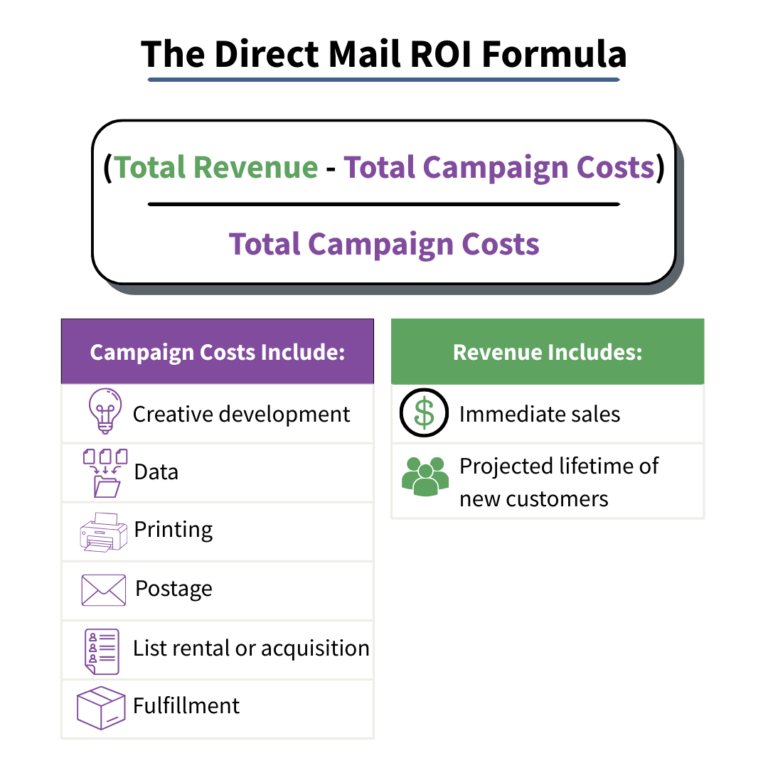
Direct mail ROI (return on investment) quantifies the financial gain of a campaign relative to its costs. Use this formula: (Total Revenue Attributed to the Campaign − Total Campaign Costs) ÷ Total Campaign Costs. Costs usually include creative development, data, printing, postage, list rental or acquisition, and fulfillment. Revenue encompasses immediate sales and, when justified, the projected value of newly acquired customers over time. Framing your analysis around direct mail return on investment keeps teams aligned on outcomes, not just outputs.
Measuring ROI ties marketing spend to business outcomes, enabling you to prioritize budgets for tactics that drive profitable growth. Without clear ROI standards, teams risk misreading performance, underfunding high-return efforts, and overspending on low-impact activities. As you benchmark direct mail marketing ROI, pair financials with operational metrics so you can act quickly when something works.
Compared with many digital programs, direct mail statistics show that they often achieve higher response rates, stronger brand recall, and sustained engagement. Digital campaigns can offer faster feedback and lower initial costs but are more susceptible to ad fatigue and privacy limitations. When personalized and targeted, direct mail cuts through noise and amplifies digital touchpoints. Top-performing marketers benchmark direct mail ROI across channels, use consistent attribution rules, and view print and digital as complementary, not competing, investments. Keep an eye on the average response rate for direct mail in your industry, then calibrate your targets to your brand, offer, and list quality.
Key Factors Influencing Direct Mail ROI
Audience segmentation determines who receives your message and drives relevance, which powers response. Leverage first-party data, predictive models, and demographic overlays to identify high-intent segments. Consider recency, frequency, and monetary (RFM) scoring, lifecycle stage, and product affinity to prioritize prospects most likely to convert. Effective segmentation reduces waste and improves cost efficiency, two direct levers for stronger direct mail marketing ROI.
Personalization and customization heighten engagement. Tailor offers, images, and copy based on recipient behavior and preferences. Dynamic elements, such as first name, location-specific offers, and product recommendations, make each piece feel bespoke. Variable data printing enables one-to-one messaging at scale, improving response rates and average order value. These tactics routinely lift direct mail ROI by improving both conversion and lifetime value.
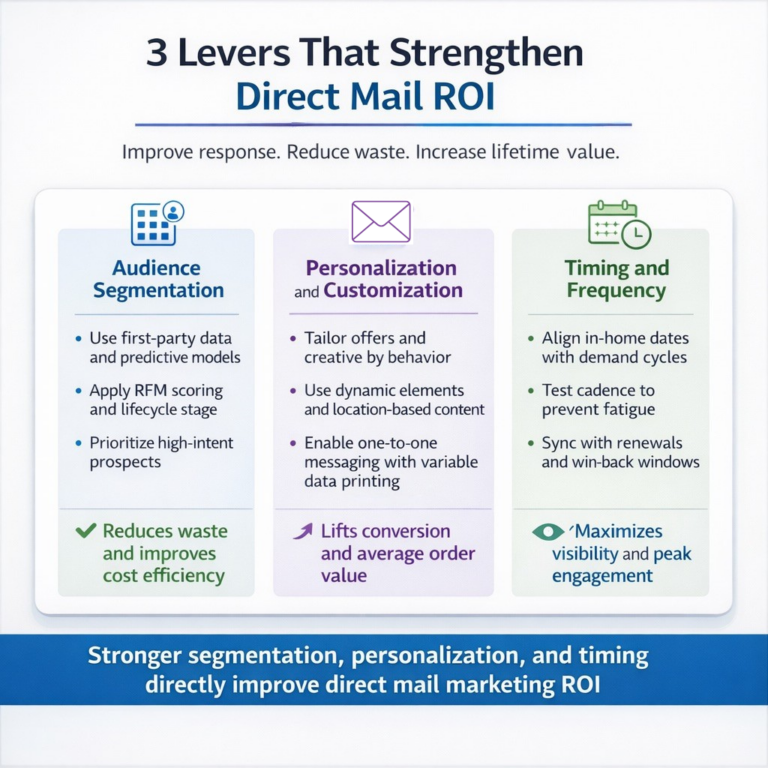
Timing and frequency affect visibility and conversion. Align in-home dates with seasonal demand, inventory, and promotional calendars. Test cadence to find the sweet spot that sustains awareness without causing fatigue. For subscription or membership programs, synchronize mail with renewal windows, onboarding milestones, and win-back periods to maximize impact. Monitoring the average response rate for direct mail by season can help you time drops for peak engagement.
Direct Mail Performance Metrics
Response rate is the percentage of recipients who take a desired action, such as scanning a QR code, visiting a personalized URL (PURL), calling a tracked number, or using a unique promo code. Conversion rate reflects how many responders complete a purchase or sign up. Track both to diagnose where the funnel succeeds or stalls and how they influence overall direct mail return on investment.
Cost per acquisition (CPA) measures efficiency: Total Campaign Cost ÷ Number of New Customers Acquired. Break out CPA by audience, format, and offer to identify the combinations that yield the best returns. When paired with average order value (AOV) and margin, CPA helps you assess true profitability and understand the drivers behind direct mail marketing ROI.
Customer lifetime value (LTV) connects near-term results to long-term revenue. Estimate LTV using retention, purchase frequency, and average spend. If direct mail brings in higher-quality customers, like those who reorder or subscribe, its ROI can exceed channels with lower upfront CPA. Model LTV by cohort and attribute appropriate value back to originating campaigns to guide scaling and bidding decisions. This holistic view prevents underinvestment in campaigns that deliver strong direct mail ROI over the long term.
- Track response, conversion, AOV, CPA, and LTV together for a complete profitability view.
- Use control groups where possible to isolate the incremental impact of mail.
- Report metrics by segment, creative, and offer to surface granular learnings that lift direct mail return on investment.
- Choose a quality direct mail vendor to handle printing and shipping.
Innovative Tools for Tracking Direct Mail ROI
Your tools matter just as much as your strategy. Here are our tips for running a successful direct mail campaign:
Analytics and attribution tools connect mail events to business outcomes. Campaign management platforms track drop dates, delivery status, and in-home windows. Link this to web analytics to record post-mail traffic, conversions, and revenue. Multi-touch attribution reveals how mail interacts with paid search, email, and social along the path to purchase, giving you a more accurate read on direct mail ROI.
Digital integrations boost measurability and performance. Assign unique promo codes, PURLs, and dynamic QR codes to each recipient to tie actions back to specific mailers. Sync your CRM and marketing automation platform to capture responses, trigger follow-up emails or SMS, and update lead scores. Unified marketing automation tools like HubSpot Marketing Hub include these capabilities by default. Retarget mail recipients with digital ads to reinforce your message and lift conversion rate, which are tangible ways to improve direct mail marketing ROI.
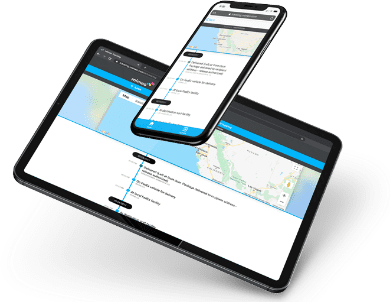
Real-time data accelerates optimization. USPS Informed Visibility provides scan data to estimate in-home dates, enabling coordination of digital bursts and call center staffing. Real-time dashboards that blend delivery, site behavior, and sales data empower teams to pause underperforming segments, scale winners, and adjust offers mid-flight in bulk direct mail services. Use dedicated call tracking numbers and IVR routing to attribute phone orders accurately and safeguard your direct mail return on investment.
Best Practices for Maximizing Direct Mail ROI
A/B testing is essential. Experiment with headlines, offers, different direct mail formats (postcards, self-mailers, letters, catalogs), and layouts. Test one variable at a time for clean reads and run tests to statistical confidence. Maintain a central learning library so insights inform future campaigns, not just the current drop. Rigorous testing is one of the most reliable ways to raise direct mail ROI above your baseline.
Customer feedback provides direct guidance. Include short surveys via QR codes or post-purchase emails to capture feedback on clarity, relevance, and value. Review call center notes and chat transcripts to surface friction points. Use Net Promoter Score (NPS) by cohort to assess whether new creative enhances brand affinity. These inputs help you refine offers and messaging that boost direct mail marketing ROI.
Production quality and partners have a direct impact on performance and speed. Collaborate with print partners on paper selection, color accuracy, finishing, and data hygiene. Choose vendors that support variable data printing, precise versioning, and robust proofing workflows. Preflight files to prevent production errors and confirm addressing compliance to reduce undeliverables. Align on service-level agreements for delivery windows so timing supports your promotional plan and protects your direct mail return on investment.
Offer strategy drives response and profitability. Provide clear, compelling value, like limited-time discounts, free trials, bundles, or loyalty incentives, anchored by a strong call to action and a frictionless response path. Communicate urgency without overpromising, and use social proof, guarantees, or return policies to reduce hesitation. Strong offers, delivered to the right audience at the right time, consistently raise direct mail ROI.
- Set a control package and iterate methodically to build on proven winners.
- Right-size formats to the value of the offer and audience; bigger isn’t always better.
- Coordinate mail with email and SMS to remind, reinforce, and convert.
Calculating and Improving Direct Mail ROI
Start with a clear financial model. Define campaign objectives, target segments, and expected response and conversion rates. Estimate costs across creative, data, printing, postage, and fulfillment. Establish baseline assumptions for AOV, margin, and LTV. With these inputs, project direct mail return on investment and set thresholds for go/no-go decisions. When possible, compare your estimates to the average response rate for direct mail in your vertical to validate assumptions.
After launch, reconcile forecasts to actuals. Compare predicted delivery windows to Informed Visibility data, and align on actual in-home dates. Analyze traffic and sales lifts in the days following delivery by segment and region. Attribute revenue using your agreed methodology, accounting for control groups and overlapping digital spend. This disciplined approach ensures your view of direct mail marketing ROI reflects true incremental impact.
Use ongoing testing to improve ROI over time. Optimize three core levers, like audience, offer, and creative, before fine-tuning format and timing. Small changes in targeting and value proposition often produce outsized gains compared with cosmetic design changes. As you learn, update your model of direct mail ROI and refresh expectations for future campaigns.
| ROI Lever | What to Test | Success Signal |
| Audience | Lookalike models, RFM tiers, suppression rules | Lower CPA with steady or higher AOV/LTV |
| Offer | Discount depth, bundles, free shipping, trials | Higher conversion with sustained margin |
| Creative | Headline clarity, imagery, proof elements | Higher response and conversion |
| Format | Postcard vs. letter vs. catalog | Improved ROI after production and postage |
| Timing | Day-in-home, seasonality, cadence | Lift in response during optimal windows |
Integrating Direct Mail Across the Funnel
Direct mail works best as part of a coordinated journey. Use it to prime interest at the top of the funnel, convert high-intent shoppers in the middle, and reactivate lapsed buyers at the bottom. Tie creative and offers to the recipient’s stage to maintain relevance and improve direct mail return on investment.
- Prospecting: Mail to modeled lookalikes supported by brand search and paid social. Use awareness-focused creative with a clear introductory offer to beat your internal average response rate for direct mail.
- Conversion: Target cart abandoners or high-intent browsers with programmatic, event-triggered mail that arrives within days and reiterates benefits.
- Retention: Send upsell, cross-sell, and loyalty communications keyed to reorder cycles or key anniversaries to lift lifetime value.
Ensure consistent messaging and identity across channels. Use unified IDs or clean-room solutions to respect privacy while maintaining measurement continuity. When you connect these dots, you not only strengthen direct mail marketing ROI but also create a smoother experience for your customers.
Future Trends in Direct Mail Marketing
Programmatic print brings automation to direct mail. Event-triggered workflows respond to real-time behaviors like cart abandonment or churn risk, dramatically shortening time-to-mail and improving relevance. This precision supports healthier direct mail ROI by mailing fewer, smarter pieces.
Enhanced connectivity via advanced QR and NFC bridges the physical and digital experience, directing recipients to rich destinations such as personalized landing pages, product configurators, or appointment schedulers. Better connections lead to clearer attribution and more accurate readings of direct mail marketing ROI.
Predictive modeling increasingly guides list selection and creative personalization, concentrating spend on higher-propensity audiences and improving ROI.
Sustainability is now a baseline expectation. Opt for responsibly sourced paper, vegetable-based inks, and efficient formats that reduce waste. Optimize print runs and targeting to minimize emissions and cost without sacrificing impact. Communicate your environmental commitments transparently to strengthen brand trust and protect long-term direct mail return on investment.
Omnichannel integration will define top performers. Coordinated plans that connect mail with email, SMS, paid media, and in-store experiences create coherent journeys. When mail primes interest and digital reinforces it, brands convert more efficiently and increase lifetime value across ABM direct mail campaigns. The future of direct mail is not standalone; it is the tactile anchor of an orchestrated, data-driven customer experience, and a consistent driver of healthy direct mail ROI.
Action Checklist to Elevate Direct Mail ROI
- Set ROI definitions and attribution rules before launch to align expectations for direct mail marketing ROI.
- Build precise segments using first-party data and predictive models.
- Personalize offers and creative with variable data printing.
- Choose formats aligned to audience and offer value.
- Instrument every mailer with PURLs, QR codes, and call tracking.
- Integrate CRM and marketing automation for timely follow-ups.
- Use Informed Visibility to coordinate cross-channel bursts.
- Test audience, offer, and creative systematically; log learnings.
- Measure CPA alongside AOV, margin, and LTV for full profitability.
- Continuously optimize based on real-time dashboards and cohort LTV, and benchmark against your average response rate for direct mail.
With disciplined measurement, targeted creative, and tight integration across channels, direct mail can be one of the most reliable growth drivers in your media mix, consistently delivering strong direct mail ROI and higher-quality customers over time. Keep your focus on direct mail return on investment, test thoughtfully, and you’ll build a program that scales with confidence.
Ready to boost your return on investment? Explore direct mail options at Mimeo today.

Brent Ervin-Eickhoff
Director of Marketing
Brent Ervin-Eickhoff is a Chicago-based marketer with B2B and B2C experience spanning corporations, agencies, and non-profits, including five years of experience in print. From Volkswagen to the University of Chicago, his background is focused in crafting marketing campaigns that drive results.

 Mimeo Print
 Mimeo Digital for Participants
 Mimeo Marketplace
 PrintX
 Mimeo Photos