




 By Paul Arnold
•
16 Dec 2025
•
Updated 21 Jul 2026
•
5 min read
•
Digital & Content Distribution
By Paul Arnold
•
16 Dec 2025
•
Updated 21 Jul 2026
•
5 min read
•
Digital & Content Distribution
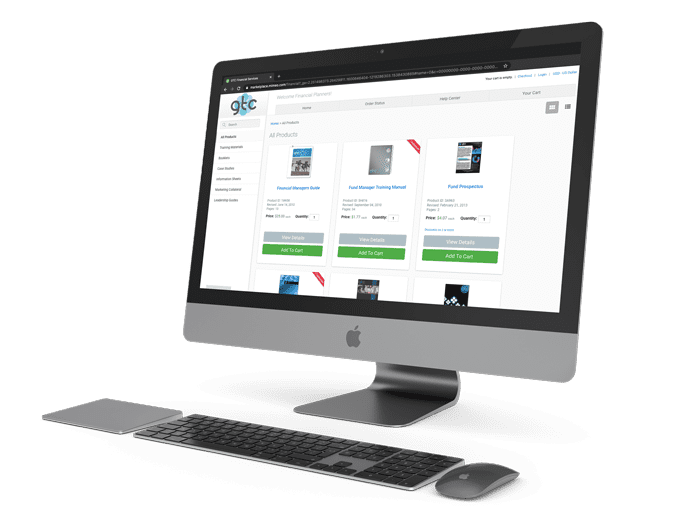
A branded storefront is a centralized, online destination where your organization’s print and digital assets live under one cohesive visual identity. More than a simple library, it combines branding, structure, and technology to streamline updates, ordering, and content distribution while supporting modern print on demand services, digital asset management, and marketing asset management. In practice, it functions like a retail-style portal where every touchpoint reflects your brand and guides users to the right materials.
Organizations create more content than ever: training guides, certification packets, onboarding kits, sales collateral, partner resources, policy updates, worksheets, handouts, digital downloads, and more. Every team produces something. Every audience needs something. Without a branded, centralized storefront, everything becomes harder to manage and harder to keep on-brand.
Materials become outdated. Teams don’t know which version is correct. Orders get bottlenecked through one or two people. Visual standards drift as people improvise their own materials. And the business misses real opportunities to distribute or even monetize high-value, brand-rich content.
A branded storefront changes that. It gives you a single, centralized place to manage your assets, present them within a consistent visual identity, and make ordering fast, accurate, and scalable. For training companies, franchise networks, associations, and any organization that relies on consistent content delivery, a branded storefront becomes the operational and branding backbone that keeps everything aligned.
The Role of Branding in a Storefront
Branding is not just a logo at the top of the page; it’s the strategy that shapes how your storefront looks, feels, and functions. In a retail-like environment, branding signals quality, trust, and relevance the moment someone lands on the page. A branded storefront uses your organization’s visual identity to create a familiar, trustworthy environment where users immediately recognize they are in the right place.
Key visual identity elements that enhance a storefront’s appeal include:
- Logo and wordmarks: Creates a branded experience with every printed material.
- Color palette and typography: Create a consistent, professional look that matches your website, marketing, and physical spaces.
- Imagery and iconography: Help users quickly identify categories, product types, and programs while conveying your brand personality.
- Brand voice in descriptions: Align product names, instructions, and calls to action with your brand tone for a unified experience.
When these elements are applied consistently, your storefront feels like a natural extension of your brand, not a generic catalog. That consistency builds trust, improves user experience, and makes it easier for teams, partners, and customers to find and order the right materials.
Essential Elements of an Effective Branded Storefront
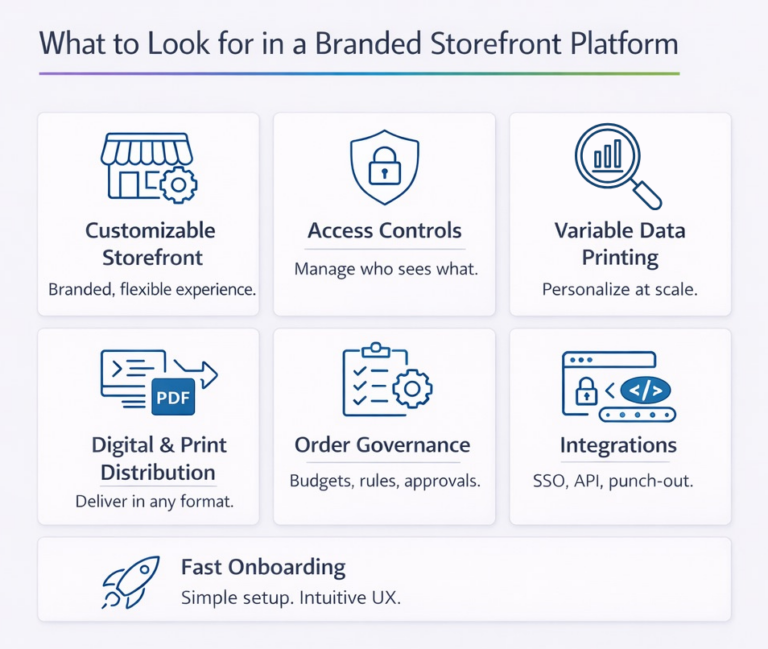
An effective storefront blends strong branding with practical functionality. To support both operations and brand consistency, look for these core elements:
- A customizable, branded interface: Apply your logo, colors, fonts, and imagery so the storefront mirrors your brand and retail presence.
- Clear structure and categories: Organize materials by audience, program, region, or product type so users can self-serve quickly.
- User access controls: Ensure each user only sees the content, pricing, and options relevant to them.
- Digital and print distribution: Offer downloads, print on demand, or both from the same branded environment.
- Order governance and approvals: Set budgets, approvals, and rules to keep spending and usage on track.
- Revenue generation tools: Sell course packets, certifications, branded merchandise, or resource kits directly.
- Integrations (SSO, API, punch-out): Connect your storefront with existing systems to reduce friction.
How a Branded Storefront Improves Operations and Brand Consistency
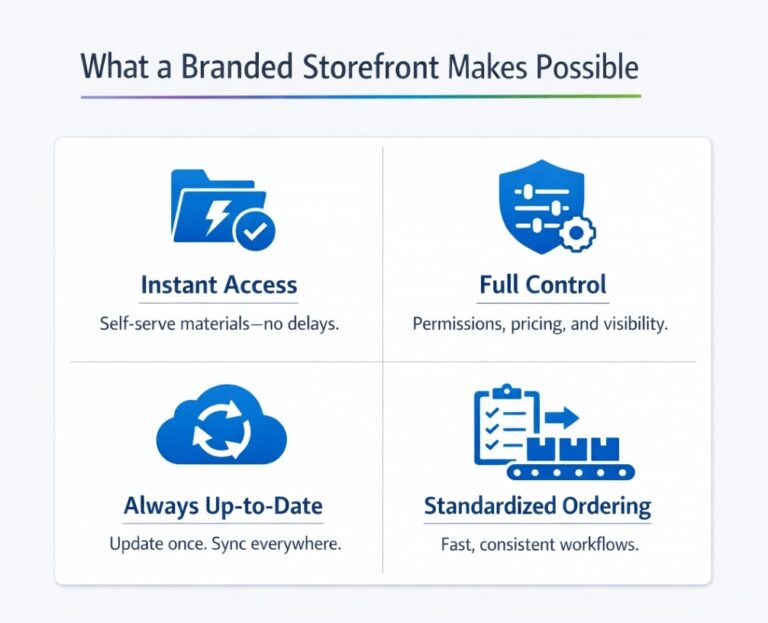
Centralizing your materials in a branded storefront eliminates friction and protects your brand at the same time. Instead of hunting for files or guessing which version is approved, stakeholders know exactly where to go and what to use. Your storefront becomes the single source of truth for all print and digital resources.
With a cohesive branding strategy applied to your storefront:
- Sales teams access on-brand collateral for every meeting.
- Instructors know participants will receive identical, high-quality kits.
- Franchise locations follow brand guidelines without manual oversight.
- Associations deliver consistent, branded value to members across regions.
- HR and L&D teams stop firefighting version issues and focus on strategy.
Updates happen in one place, and everyone automatically gets the current, brand-approved materials. Ordering becomes predictable and scalable, especially when paired with flexible print on demand services and corporate print portals.
The Benefits of a Cohesive Branding Strategy for Retail-Like Storefronts
Whether your storefront serves internal teams, partners, or external customers, a cohesive branding strategy delivers tangible benefits for any retail-style experience:
- Stronger brand recognition: Consistent visuals and messaging reinforce who you are at every touchpoint.
- Higher perceived value: Professionally branded materials and a polished storefront elevate how your content and products are perceived.
- Improved user experience: Clear, branded navigation and visuals make it easier and faster for users to find what they need.
- Reduced errors and rework: Users rely on the storefront as the authoritative, brand-approved source.
- Greater revenue potential: A professional, on-brand storefront builds confidence for external buyers and supports monetization. You can turn your branded storefront into a new revenue stream.
Bringing It All Together
Centralizing your print and digital assets in a branded storefront is one of the most effective ways to eliminate operational friction, protect content quality, and strengthen your brand. By combining visual identity, digital asset management, marketing asset management, and print on demand services in one place, you create a seamless, retail-like experience for every audience you serve.
If you’re ready to centralize your content, streamline ordering, and present everything within a cohesive, on-brand storefront, explore how platforms like Mimeo Marketplace can support your workflows and scale with your programs.

Paul Arnold
VP of Customer Success
Paul Arnold is VP of Customer Success at Mimeo, where he's spent over 13 years working directly with customers: first in account management and enterprise sales, and now leading the teams that support them. Having managed relationships with Fortune-level companies through every stage of the print buying cycle, he knows firsthand where document programs succeed and where they break down. His posts help businesses get more value from their print operations, from onboarding through long-term growth.

 Mimeo Print
 Mimeo Digital for Participants
 Mimeo Marketplace
 PrintX
 Mimeo Photos