




 By Chris Uhler
•
25 Sep 2018
•
Updated 6 Oct 2026
•
6 min read
•
Industry Applications
By Chris Uhler
•
25 Sep 2018
•
Updated 6 Oct 2026
•
6 min read
•
Industry Applications
Customer retention is one of the most important growth levers for any SaaS business. While acquiring new customers often gets the spotlight, retaining an existing customer has a much greater financial impact over time. For many SaaS and technology organizations, customer retention training plays a direct role in that outcome. The challenge is proving it.
This article explores how one SaaS company built a measurable customer retention strategy through structured customer training. It shows how a digital, online course approach helped the team connect learning outcomes to retention rate, loyalty, and long-term business performance. It also offers a practical guide for training leaders who want to optimize their own programs and demonstrate real impact.

Customer Training as Part of Customer Support
At SaaS companies, customer training often starts with onboarding. The goal is to build a customer service training manual to learn the system quickly, apply key concepts, and see value early. But strong retention strategies go far beyond the first course.
Ongoing education helps customers build deeper knowledge of the product, adopt advanced features, and strengthen their relationship with the brand. When customers understand how to use a platform well, they rely on it more, contact support less often, and are more likely to renew.
At Bonterra, a SaaS provider serving nonprofit and government organizations, customer training became a core retention strategy. Their team recognized that training was not just a support function. It was a driver of customer loyalty, performance, and long-term success.
From Customer Support to Dedicated Training Program
Bonterra develops outcomes management software used by human services organizations. Their customers depend on the system to track data, demonstrate impact, and meet reporting requirements. That makes effective training essential.
Originally, the training team existed within customer support. As the business grew, that structure became limiting. Training needed its own program, clear goals, and a strategy designed around customer retention rather than reactive service.
Under the leadership of Jessica Coburn, the team evolved into a standalone group focused on helping each customer become an independent, confident user. The goal shifted from short-term sales enablement to long-term retention and relationship building.
Redefining Customer Training Goals
A key step was redefining what success looked like. Instead of focusing on how many courses were delivered, the team centered goals on behavior change and independence.
The primary objective became helping each customer complete a course with confidence, apply learning to real-world scenarios, and manage the system without constant assistance. This approach supported stronger customer loyalty and reduced friction throughout the customer lifecycle.
Clear goals also made it easier to align training with retention strategies and broader business priorities.
Building a Measurable Customer Retention Framework
To prove impact, the team developed a structured measurement strategy using the Kirkpatrick Model. This framework allowed them to evaluate training at multiple levels and connect learning outcomes to business results.
Each course included a clear description, defined requirement, and detailed course content. Learners could access training online, complete modules on a flexible schedule, and return to materials as needed.
This structure ensured consistency while allowing individual customers to learn at their own pace.
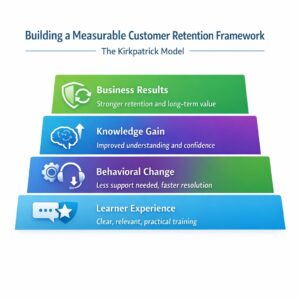
Level 1: Learner Experience and Course Feedback
At the first level, the team measured immediate learner reactions. After completing a course module, participants submitted feedback through a structured assignment.
This data helped the team understand whether the course was clear, relevant, and practical. It also highlighted opportunities to improve content, delivery, and overall course design.
Capturing early insight ensured that training remained aligned with customer expectations and needs.
Level 2: Knowledge Gain and Perception Change
The second level focused on learning outcomes. The team measured how much knowledge customers gained and whether their perception of the software changed after training.
Pre-course and post-course assessments helped track understanding and confidence. These metrics confirmed that the course was teaching the right concepts and preparing customers to apply what they learned.
This level was essential for validating the effectiveness of the training program itself.
Level 3: Behavioral Change and Support Impact
At the third level, the team analyzed behavior. They reviewed customer service data to see how training influenced support usage.
Customers who completed training courses contacted support less frequently and resolved issues more efficiently. This indicated that training helped customers retain knowledge and apply it in real situations.
Reduced support demand also improved service quality across the business, benefiting both customers and internal teams.
Level 4: Retention Rate and Business Outcomes
The final level connected training to customer retention. The team examined correlation metrics such as implementation timelines, ongoing engagement, and renewal behavior.
Customers who completed training courses were more likely to remain active clients and maintain long-term relationships. Training played a measurable role in retaining existing customers and stabilizing revenue.
These insights helped demonstrate the financial impact of training and reinforced its role as a strategic investment.
Why Measurement Matters
A clear measurement strategy made it possible to move beyond assumptions. Instead of relying on anecdotal feedback, the team could present data showing how training influenced customer retention, loyalty, and performance.
Measurement also supported continuous optimization. By reviewing results, the team could refine course content, adjust modules, and apply proven techniques more consistently across the program.
This step-by-step approach ensured that training continued to deliver value as customer needs evolved.
Designing an Effective Online Course Experience
Course structure played a major role in success. Each course included a course overview outlining objectives, modules, assignments, and expected outcomes.
The online format gave customers flexible access while maintaining a comprehensive learning experience. Courses were designed to be practical, focused, and directly related to real customer workflows.
In some cases, customers could earn a certificate after completing the program, supporting professional development and reinforcing long-term engagement. Check out the ultimate guide to training your tech support team for more.
Extending Training Into Customer Loyalty
Training did not end when a course was complete. Education was treated as an ongoing program that supported customer management and communication efforts.
Insights from training informed marketing strategies, loyalty programs, and customer outreach. Training content also supported sales conversations by demonstrating commitment to long-term customer success.
This integrated approach strengthened customer loyalty and reinforced the value of ongoing education.
Applying This Strategy to Your Organization
For teams looking to adopt a similar approach, alignment is key. Start by defining how training supports customer retention and business goals.
Design each course with clear outcomes, measurable assignments, and practical application. Track data across learning, behavior, and retention metrics, then use those insights to continuously improve.
Customer retention is influenced by many factors, but effective training plays a critical role. When customers understand your product and feel confident using it, they are far more likely to stay.
Customer Training as a Long-Term Advantage
This case study demonstrates that customer training is not just an educational initiative. It is a strategic tool that can improve retention, strengthen relationships, and deliver measurable business impact.
By treating training as a structured, optimized program, SaaS companies can turn education into a long-term advantage that benefits both the customer and the business.
Want to improve customer retention through training? Explore how Mimeo helps teams design, deliver, and measure customer training programs that drive long-term loyalty.
Chris Uhler
Director, Sales Development
Chris Uhler is Director of Sales Development at Mimeo, with more than 18 years of sales leadership experience spanning retail, pharmaceutical, and education industries. Known for building high-performing teams and strategic partnerships, he specializes in coaching talent and developing go-to-market strategy in complex marketplaces. His posts help businesses tackle print and distribution challenges with a strategic, team-driven approach.

 Mimeo Print
 Mimeo Digital for Participants
 Mimeo Marketplace
 PrintX
 Mimeo Photos