


 By Shari Cooke
•
30 Oct 2026
•
7 min read
•
Design & Print Production
Cardstock, also called cover stock, is thick, rigid paper for business cards, postcards, and the covers of booklets and reports. Text weight paper is thinner and more flexible, made for flyers, brochures, letterhead, and interior pages. Most multi-page projects use both: cover stock on the outside for protection and text weight inside for easy reading.
Below, we break down how paper weights work, when to use each stock for covers and inserts, and the right weight for common print products. That way you can order with confidence on our online, on-demand print platform.
What is the difference between cardstock and text weight paper?
The difference comes down to thickness, stiffness, and purpose. Cardstock is built to be handled. Text weight is built to be read.
Cardstock (cover stock)
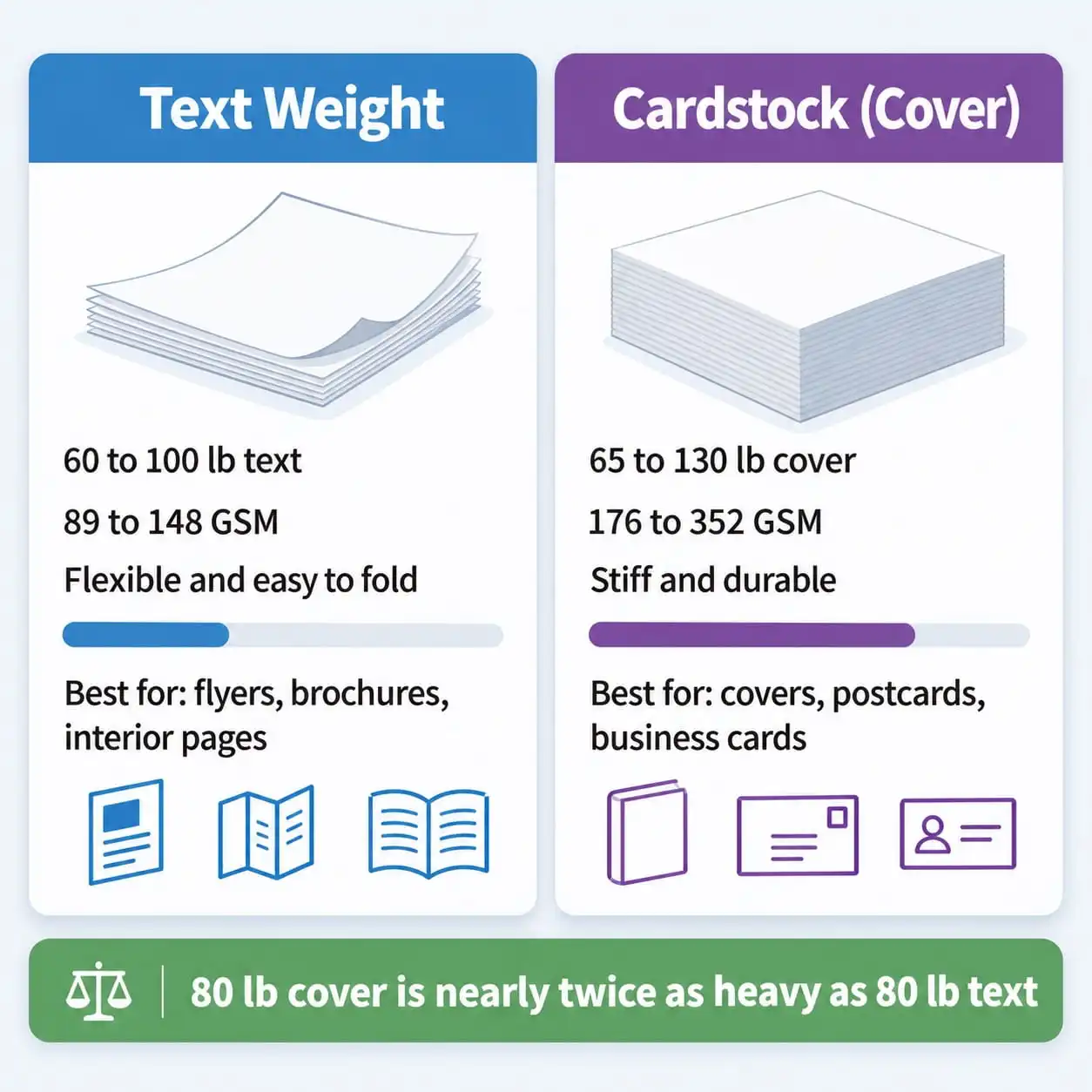
- Common weights: 65 to 130 lb cover (about 176 to 352 GSM, or grams per square meter)
- Feel: Stiff and durable, holds its shape
- Best for: Business cards, postcards, booklet and report covers, invitations, presentation folders
Text weight paper
- Common weights: 60 to 100 lb text (about 89 to 148 GSM)
- Feel: Flexible, folds easily, turns like a book page
- Best for: Flyers, brochures, newsletters, letterhead, manual and book interiors
You may also see bond paper, which is standard office and copy paper. 20 lb bond is about 75 GSM, slightly lighter than 60 lb text.
Why is 80 lb cover paper heavier than 80 lb text?
In the U.S., pound weight is the weight of 500 sheets at the paper’s “basis size,” and text and cover stocks use different basis sizes. Text is measured at 25 x 38 inches. Cover is measured at a smaller 20 x 26 inches. Because the cover sheets are smaller, the same pound number means a much heavier sheet.
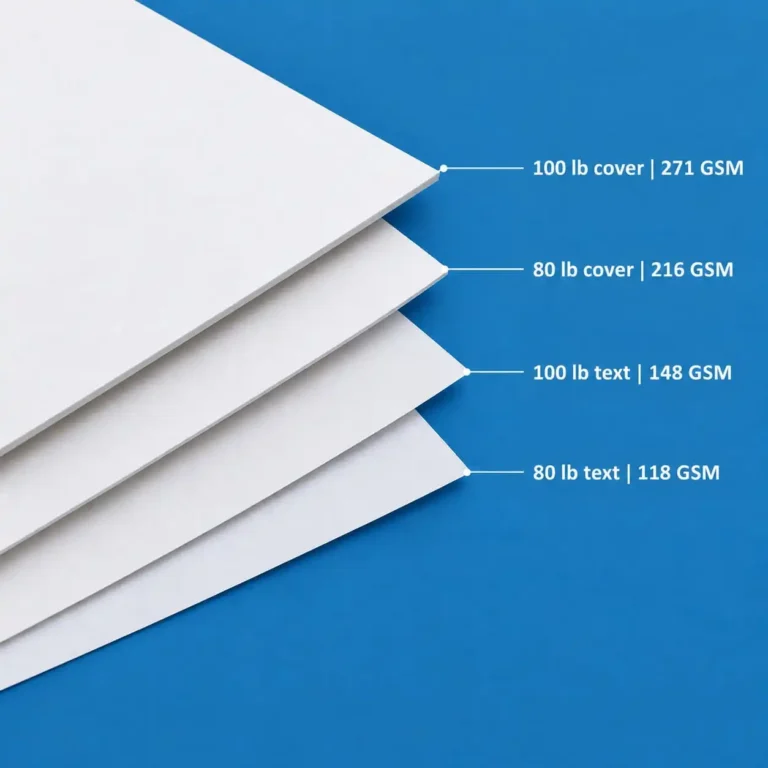
The result: 80 lb cover is about 216 GSM, while 80 lb text is about 118 GSM. The cover sheet is nearly twice as heavy.
GSM (grams per square meter) measures every paper the same way, so it’s the easiest way to compare across families:
| Stock | Approx. GSM | Typical feel |
|---|---|---|
| 60 lb text | 89 | A step up from copy paper |
| 70 lb text | 104 | Solid newsletter or manual page |
| 80 lb text | 118 | Quality flyer or brochure |
| 100 lb text | 148 | Premium brochure, still foldable |
| 80 lb cover | 216 | Light cardstock, report cover |
| 100 lb cover | 271 | Sturdy postcard |
| 110 lb cover | 298 | Business card |
| 130 lb cover | 352 | Thick, premium card |
Deciding between two weights in the same family? Our breakdown of the key differences between 80 lb and 100 lb paper compares stiffness, opacity, and folding side by side.
Should you use cover stock or text weight for covers and inserts?
Use cover stock for anything that protects, stands up, or gets mailed. Use text weight for pages people read, fold, or file. Loose inserts depend on the job.
Covers
For booklets, reports, and manuals, 80 to 100 lb cover gives you structure without excess bulk. Go heavier for pieces handled daily, like reference guides or sales leave-behinds. Score cover stock before folding so it doesn’t crack along the spine.
Bound documents give you more options. With spiral, comb, or twin loop binding, you can add a clear, matte, or frosted front cover with a black, white, or navy back, or use cardstock cover pages. If you’re still weighing binding styles, start by choosing between saddle stitch and wire-o.
Want a lighter, lower-cost piece? A self-cover booklet prints the cover and interior on the same text stock. It works well for event programs and short-life materials.
Interior pages
Text weight is the default for interiors. Use 60 to 80 lb text for manuals and book-style documents, and 80 to 100 lb text for brochures and image-heavy pages. If you print double-sided with heavy ink coverage, a heavier text weight cuts show-through.
Loose inserts
- Folder inserts and sell sheets: 80 to 100 lb text is easy to file, annotate, and swap out. Step up to 80 lb cover if the sheet needs to stand upright in a pocket.
- Reply cards and mail-back inserts: Use postcard-weight cover stock so they hold up in the mail.
- Training handouts and worksheets: Uncoated text weight takes pen and pencil best.
What paper weight should you use for each print product?
| Product | Cover or outside | Interior or body |
|---|---|---|
| Business cards | 110 to 130 lb cover | Not applicable |
| Postcards | 100 to 120 lb cover | Not applicable |
| Flyers | Not applicable | 80 to 100 lb text |
| Brochures | Not applicable | 80 to 100 lb text |
| Newsletters | Not applicable | 70 to 80 lb text |
| Booklets and catalogs | 80 to 100 lb cover, or self-cover | 70 to 100 lb text |
| Manuals and training guides | 80 to 100 lb cover, or clear front cover | 60 to 80 lb text, or 20 to 24 lb bond |
| Presentations and proposals | 80 to 100 lb cover, or clear front cover | 70 to 80 lb text |
| Marketing folders | 100 to 130 lb cover | Inserts: 80 to 100 lb text |
Do coatings matter for cardstock and text weight paper?
Yes. Finish matters as much as weight because coatings control how ink sits on the paper and how the piece feels in hand.
- Uncoated: Natural feel, softer color, easy to write on. Best for forms, workbooks, and letterhead.
- Matte: Smooth with little glare. A refined choice for reports and manuals.
- Silk or satin: Between matte and gloss. Rich color that stays readable.
- Gloss: Maximum shine and color pop. Great for postcards and photo-heavy pieces.
Specialty finishes like spot UV and soft touch pair best with coated cover stock.
How do you choose the right paper stock for your project?
Run through a few quick questions before you order:
- Will it be mailed, handled often, or need to stand up? Choose cover stock.
- Will people read many pages, fold it, or write on it? Choose text weight, uncoated if they’ll write.
- Is it double-sided with heavy ink? Step up your text weight or pick a coated stock.
- Does it fold? Text weight folds cleanly. Cover stock needs scoring.
- How often will the content change? If you update printed training manuals or custom proposals for clients regularly, print on demand so you only produce what you need.
In Mimeo Print, you upload your file and choose your stock, binding, and cover in one place. Place your order by 10 p.m. and get it delivered as early as 8 a.m. the next day. If your teams reorder the same materials, Mimeo Marketplace locks in approved specs so every run uses the right paper.
Still unsure? Our team can send paper samples so you can compare weights and finishes in hand before you commit.
Frequently Asked Questions
Is 80 lb paper cardstock?
Only 80 lb cover is cardstock. 80 lb text is a mid-weight paper used for flyers and brochures.
Is 100 lb text paper considered cardstock?
No. At about 148 GSM, 100 lb text is closer to 55 lb cover, lighter than the lightest common cardstock. It feels substantial but still folds like paper.
Is cover weight the same as cardstock?
Yes. “Cardstock” is the everyday term, and “cover weight” is how printers spec it.
What GSM is cardstock?
Most cardstock falls between about 175 and 350 GSM.
What cardstock weight is best for postcards?
100 to 120 lb cover. It resists bending in the mail and holds color well, especially with a gloss or silk finish. To mail at postcard rates, standard-size cards need to fall within the USPS thickness requirements for postcards, so confirm the caliper (thickness) of your stock with your printer.
Can office printers handle cardstock?
Many desktop printers struggle with heavy cover stock, so check your printer’s maximum supported weight. Commercial digital presses handle it routinely.
Ready to match the right stock to your next piece? Talk with our print specialists about your project and we’ll help you pick paper, binding, and finish based on how it will be used.
Things to remember
- Cardstock and cover stock are the same thing: rigid paper built for handling.
- Text weight is flexible paper built for reading, folding, and filing.
- Compare across paper families with GSM, not pounds.
- 80 lb cover is nearly twice as heavy as 80 lb text.
- Put covers on cover stock and interiors on text weight, or use a self-cover for lighter pieces.
- Score cover stock before folding.
- Choose uncoated paper when people need to write on it.
What you should read next

Shari Cooke
Director of Customer Service
Shari Cooke is Director of Customer Service for Mimeo Business US, with more than 12 years at Mimeo and a background in graphic design that gives her a unique eye for both the creative and operational sides of print. Based in Memphis, she leads the team that keeps customer orders running smoothly from file to delivery. Her posts help businesses avoid common print pitfalls and get professional results, drawing on years of solving real customer challenges firsthand.

 Mimeo Print
 Mimeo Digital for Participants
 Mimeo Marketplace
 PrintX
 Mimeo Photos